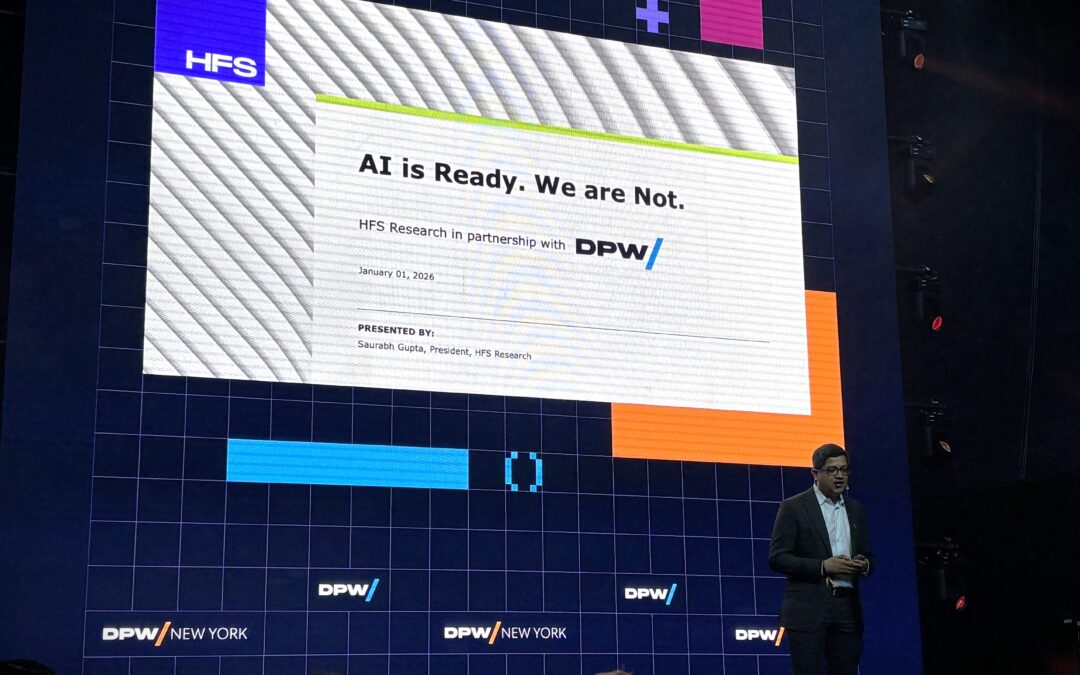
Sometimes at a conference, a talk just lands. It’s well-articulated, from a reputable source, and delivers the message in such a way that we can hear it. This happened to me twice this conference season (it’s a good year!), and this second time was about AI. The current chatter about AI in the procurement conference circuit is LOUD indeed. Practitioners are terrified the AI revolution is here and they’re going to be left behind, so it’s causing a scramble to “not be the last to implement.” Amidst the noise, Mr. Saurabh Gupta from HSF Research got on the DPW stage and said out loud what the quiet voice in my head has been telling me: The AI tools are here, and they are ready, but we haven’t done our homework. We haven’t paid our corporate debts. The same way e-auctions expose poor scopes of work and weak supplier relationships, AI is exposing messy data, broken processes, empty metrics, and unused system capabilities. Today let’s talk through Mr. Gupta’s short but impactful talk, and how we owe it to our stakeholders to think about the human side of AI.
State of AI: Overview
Mr. Gupta conducted surveys of procurement leaders, asking what they thought of AI and how they are using their AI tools. The dominant emotions around AI are excited and anxious, which is very telling. People are excited what AI tools can do, but anxious about how to use them, and what AI means for people personally. Mr. Gupta noted we’ve fully moved away from Robotic Process Automation (RPA), rebranding that same functionality as Agentic AI. For those of you who, like me, once sourced an RPA contract, it might help if every time someone says “Agentic AI,” you mentally replace it with “RPA.” I agree it’s been years since I heard someone use the term RPA.
Mr. Gupta also noted the sheer size of tech and AI specifically. There is approximately $700 billion in spend on AI, which explains why conference exhibit halls are full of chatter on AI tools and adding AI functionality to existing tools. Saurabh noted that “most enterprises are buying AI faster than becoming intelligent themselves.” Chip-maker NVIDIA has a market cap of $5.4 trillion. As a point of reference, annual healthcare spending in the U.S. is $5.6 trillion while the entire GDP of Germany is $5.4 trillion. AI powerhouse Anthropic’s anticipated IPO valuation is a whopping $1 trillion (almost 20% of the GDP of Germany). My note on all of this is that I continue to see all the signs of an AI bubble. Either way, the market is huge, so what do we do about it?
Balanced Scorecard: The 4Ps
Dr. Gupta emphasized the importance of measuring AI on more than simply productivity, and he offers an alternative. These “four Ps” of AI can round out measuring evaluating AI and whether it’s actually driving value for an organization.
- Performance – 48% of procurement leaders expect AI to help make their organization more agile and responsive. This is the “make us better” or quality metric, including enhancing services and products.
- Personalization – 30% of procurement leaders expect AI to help improve their customer and employee experience. This means AI customizes to each person the experience they need based on their own culture, learning style, environment, etc.
- Prediction – 56% of procurement leaders expect AI to improve data-driven decision-making. Procurement has been using data to drive decisions since we first started, but data continues to get bigger and more complicated. This might be the one that worries me most because we have multiple examples where AI tools “hallucinate” when interpreting data, or even make up data to try to make a complete prediction.
- Productivity – 52% of procurement leaders expect AI to help reduce headcount, drive efficiency, and add automation to their processes. Five or ten years from now, this will be the metric we look back on as a trap, and it simply isn’t sustainable if not also supported by the other three metrics. Mr. Gupta highlighted the way emphasizing productivity will cause fear and fail to capture the full value AI can bring.
I see so many parallels between this AI balanced scorecard and what procurement professionals do every day. We cannot simply drive cost savings, we have to balance in risk, quality, delivery, and speed. Procurement often struggles with becoming a “cost reduction only” department and articulating our value in these other areas. AI is quickly heading down the same path unless we find ways to stop it.
Why Are We Speeding Toward AI?
Saurabh Gupta was willing to call out what we’re all thinking: sometimes we’re implementing AI for reasons other than value. Twenty percent of his survey respondents cited some sort of Fear of Missing Out/FOMO driving their AI adoption. No one wants to be the last one to make their company “better,” so people are simply racing to do what everyone else is doing.
Nineteen percent of respondents said someone on their board or executive team read an article about the impact of AI on a plane and then wanted the company to do it. Yikes. I’ve been on the other end of that conversation before, where an executive saw something and wants to do it without understanding the implications. Sometimes The Wall Street Journal has more power than it realizes in driving what companies do.
Finally, fourteen percent of respondents said that employees are using AI (mostly LLMs) in their personal lives and want to bring that experience to their work. Of these three non-value-driven reasons for implementing AI, this might be my favorite because at least it’s coming from the front line instead of being pushed down from the top. It reminds me of the Amazon effect on online retail when everyone’s online interface suddenly had to be as easy to use as Amazon’s because it’s what people were used to.
The Eight Pitfalls/Debts Preventing AI Adoption
“Everyone” is running a proof of concept right now, but Mr. Gupta noted that so many of these POCs then go nowhere. So how do companies prevent their AI ambitions from “draining away?” This is the core of Saurabh’s talk and is where I found a lot of value. All of these are pitfalls or “debts” companies are carrying, preventing them from either implementing AI at all, or preventing smooth implementation.
- Agentic washing – Everyone is trying to be “AI First” instead of asking if a certain process or topic should be AI second, instead prioritizing how the tool fits into the ecosystem.
- Obsession with cost reduction – This ties to Mr. Gupta’s note about productivity as the only “P” on the scorecard. Don’t let the business case for AI hinge solely on headcount.
- Data debt – This one is huge and everywhere. Quality data is needed, not large quantities of messy data. Saurabh quoted a sobering fact: For every dollar a company spends on AI, they will need to spend $3.50 cleaning up and storing data.
- Process debt – We cannot automate chaos. AI is not a band-aid, and we have to have good processes to automate or we’re just speeding up a bad process.
- Tech debt – Most companies have a huge mess of legacy software, tools, etc. Introducing AI doesn’t clean up the mess, it adds to it. We have to decide which tools stay and which go first. This was definitely echoed by the panel on purchasing AI I talked about in last week’s article.
- Talent debt – When the value proposition of AI is to reduce headcount, it’s no surprise that “headcount” doesn’t want to help implement it. Employees don’t support something that’s clearly only to replace them instead of making their job easier or letting them do more interesting things with their time.
- Ecosystem challenges – AI tokens are the new currency, and procurement doesn’t really know how to negotiate them. How many tokens do we need? What should they cost? AI is new enough we simply don’t have the experience (on either the sales or purchasing side) to figure out what tokens are worth. This one might not get better until we simply have the experience under our belts, earned the hard way. My note here will be no surprise: the fastest way to get to market price for anything is to run an e-auction. So if you have the data on how many tokens you need (always a challenge), you can always reverse auction the cost per token. Alternatively, you could run one with multiple lots and different price points based on volume, then find the best overall supplier but lock in pricing for more or fewer tokens. If you want to talk about strategy for AI tokens for your exact scenario, please reach out and let’s chat.
- Legacy deal structures – similar to the ecosystem problem, buying and selling AI in units of Full Time Equivalents/FTEs is like measuring movie streaming bandwidth in units of DVDs shipped.
Moving Forward
So how many organizations are being held back by these debts? According to Saraubh Gupta, most of them. 91% of organizations have process debt and need to optimize and digitize their processes. 97% of companies hold technology debt and need to build one unified, AI-native stack to enable end-to-end execution. 95% of businesses have talent debt and need to build both AI fluency and buy-in among their team. Last, 95% of companies deal with data debt and need to clean and unify data that can be trusted.
And what about procurement? Where are we in all of this? The sad answer at least in most places is where we’ve always been: outside, looking in, and dealing with the fallout. Seventeen percent of procurement teams actually own their AI decisions, the other 83% don’t. Procurement is involved in AI strategy at only 6% of companies, and at 28% of companies procurement has a seat at the table when deciding on AI. As with many things from our technical teams, 77% of our contribution is downstream, reactive, and non-strategic. It’s the classic, “I’ve negotiated this deal with an AI vendor, go get it signed for me” directive. (Those of you who have been reading for a while or know me well might notice my use of the word “vendor.” No matter how strategic this AI software might be, suppliers are vendors and not supplier partners when they go around procurement like this.)
What can procurement teams do to reengage with the AI conversation? According to Mr. Gupta, we need to do two things. First, we need to transform procurement with AI. This means using all four P’s to determine success, pay our debts, and stop celebrating pilots. My angle on this is that if you have an auction program, it tends to uncover some of your debts. Do you have suppliers you can lean on for help, or do you have vendors? Are you buying what you think you’re buying and meeting needs without unused software capability? Are you truly tracking your contracts, RFPs, and procurement activity with clean data? Are your team members ready to embrace and facilitate inevitable change in whatever form it’s taking? I’ve personally seen e-auction programs uncover all of these opportunities, and AI is simply the latest change that needs these debts paid.
Second, we as procurement teams need to become an ecosystem builder for AI. This means building a registry of software tools in use, including what is AI First and what actually should be. It means redesigning supplier relationships around AI, accounting for this change in our supplier relationships. Lastly, being an ecosystem builder means mapping your token economy before it leaves you behind. Recognize tokens are a new measure of value, and start figuring out how to negotiate for them.
If you’d like to talk about your AI, corporate debt, or anything else, let’s chat. If you’d like to get these articles weekly straight to your inbox and never miss one, sign up for my newsletter.
My book, Transform Procurement: The Value of E-auctions is available in ebook, paperback and even hardcover format: https://www.amazon.com/dp/B0F79T6F25
My chapter in the powerful anthology Femme Led: Hard-Learned Lessons from Women in Leadership is now available in ebook and paperback format: https://a.co/d/0bOzma8F