
Summer has always felt like the beginning of my year instead of January. Part of that is all the years of being a student with an academic year starting in late August and ending in May, but there’s just something about summertime that’s full of energy and promise. I still drink a lot of water due to the summer my “summer resolution” was to drink the recommended amount of water each day. I note this because I see a lot of new beginnings around me, and many new supply chain leaders taking on new or larger roles. With our “new normal” absolutely fraught with supply chain challenges, most businesses can’t afford a supply chain leader that takes time to spin up. So let’s talk about the specific things needed to make a new supply chain/procurement leader successful, beyond and other than what it takes to make any new leader successful. (For the purposes of today’s article, I’m going to use supply chain and procurement somewhat interchangeably. I understand they’re different, but at many companies the leadership roles are similar or overlap significantly in this space.)
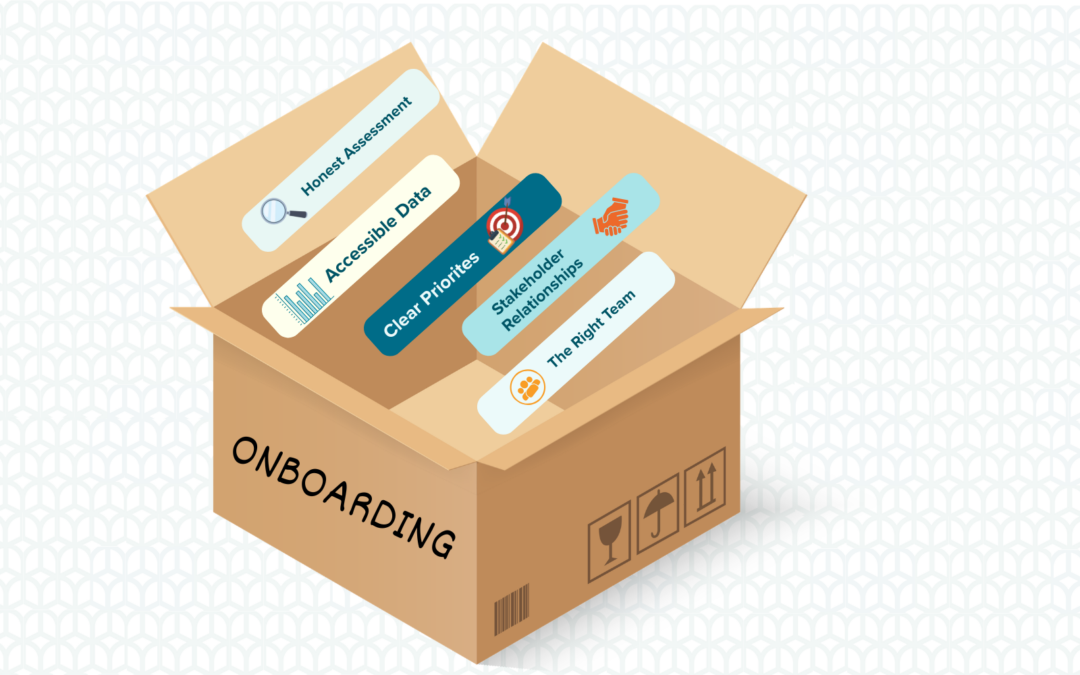
Honest Assessment
Regardless of who a supply chain leader reports to, success starts with an honest assessment of the supply chain. It’s like any process improvement activity: the first step is to Map the Current State. You don’t know where you can or should go next if you don’t know where you are. Maybe you think you have a relatively mature, sophisticated supply chain, but really you’re still spending most of your time chasing POs. Or perhaps you think your purchasing team is spending all their time cutting POs when in reality they’re proactively bidding, negotiating, and running a well-oiled procurement process. Either way, give a new leader a clear picture of the entire supply chain as early as possible. Having that baseline in the first few days of a new leadership role can make a tremendous difference in knowing where to focus first.
Side Note: If you’re looking for a place to start, I offer a Supply Chain 360 Assessment that provides a one-page executive summary, including a quick spend analysis. It requires a data dump from your PO system and about an hour of interviews with each of three team members. I can typically complete the assessment in two weeks, and I guarantee potential savings of at least 500% of the investment. I’ve had multiple clients use this assessment when bringing in a new leader so they could start with a clear State of the Supply Chain on Day One; and hit the ground running.
Stakeholder Meetings
Relationships are everything in running a supply chain. Whether a new supply chain leader is in your supervisor or subordinate chain, help set up meetings with their key stakeholders so they can start building those relationships. (If these are stakeholder staff meetings, make sure you glance through my article on attending internal customer staff meetings first!) Ideally these first meetings have almost no agenda; they’re for building a new relationship, perhaps noting some things those customers feel the supply chain team does well or could do better, and starting a conversation. In person meetings are best, but video calls can also work. Definitely don’t send out an email to all VPs announcing a new procurement leader and then go dark for six months. Calendars can be really tricky to schedule, so help someone who’s new get those key meetings scheduled early.
Data
A good supply chain leader can understand and use data to diagnose and communicate ideas for better decisions. A great supply chain leader listens to the people on their team who can analyze, process, clean, and build insightful data sets. Whatever path is the right one for your organization, do what you can to get your new leader access to data (clean, accessible data is also a primary path to becoming an AI-enabled organization). Ideally, that means having spend analysis tools, clean data, and maybe a few AI tools processing data or keeping it clean along with at least one analyst with sufficient authority to pull and process data using these tools. At the very least, it means a data dump of purchase order lines so the new leader can run their own spend/supplier/category analysis. Wherever you fall on that data spectrum, from Excel data dump to sophisticated tool and experience set, help your new leader access some decent data to make decisions.
Iron Triangle
The primary interplay within every supply chain is the one between cost, quality, and speed, also known as the iron triangle. The old adage is: “You can have it fast, you can have it good, you can have it cheap: pick two.” In some organizations, the emphasis is so strongly on one that you only achieve low cost, high quality, or speed at the expense of the other two. All of this is relevant to a new supply chain leader because a fractured supply chain is one where every person chooses a different priority. Some team members prioritize cost/savings. Some emphasize short lead times and just-in-time delivery. And the remaining team members consistently pay more for excellent quality, even above and beyond that required by the scope of work. To build an effective and efficient supply chain, a leader needs to understand and practice alignment with the company’s priorities. Be clear on the order of iron triangle priorities, including first, second, and third priority, or give the new leader the authority to decide the priority in alignment with company culture. Executive leaders must have the courage to prioritize the iron triangle and understand that while we always want all of them, the reality is that there must be a choice.
Personnel
I’ve written previously about the personalities you find in a supply chain team, and each personality has strengths and weaknesses. That is all well and good, but any of these personalities can also be something else: someone who needs to leave the organization. Once when I took over as a sourcing leader, I inherited someone my predecessor thought should be fired. While I always try to give people the benefit of the doubt, in this case the person was fraudulently working two full-time jobs for two different organizations, making use of the work-from-home standards at the time and doing neither job well. My predecessor suspected it and yet did not fire this employee. As a result, it took me a very long time to rework through that process, dragged the whole team down, and was an unwelcome distraction when there were so many other problems to solve. Do your best to give your new leader a good team and tie up any loose ends. As a new leader, I’d rather have an open position to fill than inheriting a toxic team member who causes my other team members to underperform.
Consider also reviewing my article on the pitfalls of a new supply chain leader, especially if you are the new leader’s direct supervisor.
If you’d like to talk about supply chain assessments, leadership, or anything else, let’s chat. If you’d like to get these articles weekly straight to your inbox and never miss one, sign up for my newsletter.
My book, Transform Procurement: The Value of E-auctions is available in ebook, paperback and even hardcover format: https://www.amazon.com/dp/B0F79T6F25
My chapter in the powerful anthology Femme Led: Hard-Learned Lessons from Women in Leadership is now available in ebook and paperback format: https://a.co/d/0bOzma8F