
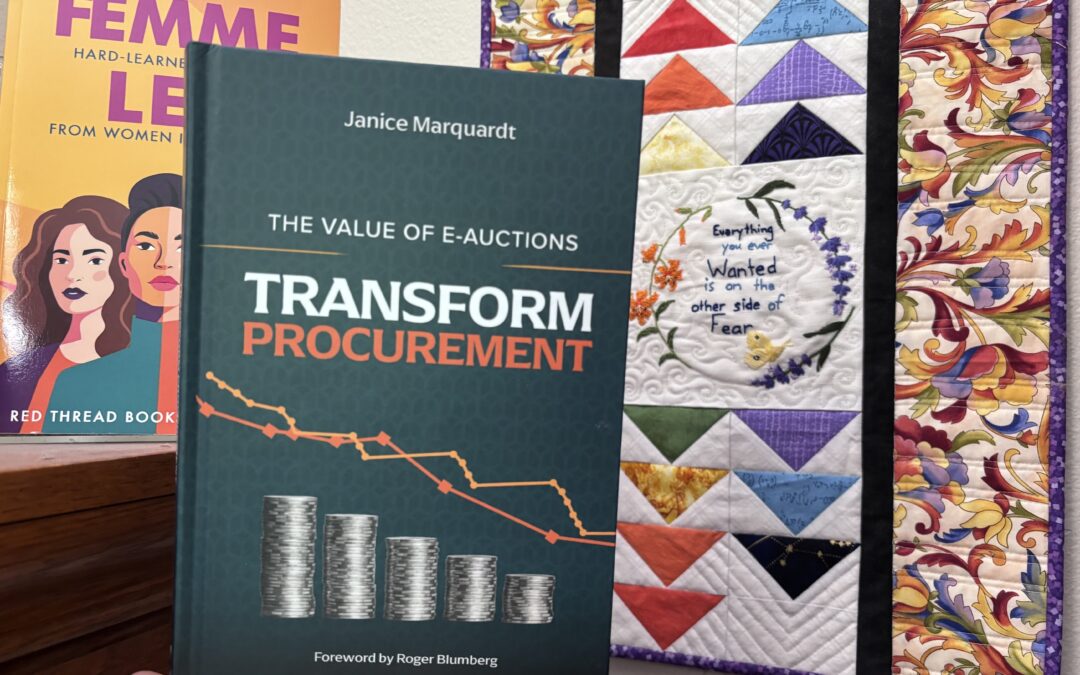
My book has been out for a year as of the date this post publishes. This is a date primarily of personal significance, but gives me a chance to highlight some third party reviews and reflect a little on becoming an author. I know some who read these articles are interested in becoming authors (or are already!), so I hope my reflections prove useful. If you haven’t yet picked up a copy of Transform Procurement: The Value of E-auctions, you can do so here! If you’re interested in my journey leading up to publishing, check out my post from a year ago here. And if you have a copy and wish you had a digital copy of the graphics or the Excel Gantt chart at the back, you can get that for free here (on the right side of the page)!
Third Party Review – Literary Titan
Literary Titan is a third party who reviews books of all kinds and conducts author interviews. They reviewed my book recently, and I love their characterization that “fairness is not always the same thing as friendliness.” This is so true and is exactly what I’m going for: when procurement professionals work with suppliers, our job is to be fair, and to gain value for as many parties involved as possible. Our job is not to be friendly, although we can still be courteous and warm. I’m going to put the full review here, and then follow it up with the interview questions and answers they sent that have not yet been published.
Literary Titan Review of Transform Procurement:
Transform Procurement: The Value of E-Auctions is a practical, clear-eyed guide to building an e-auction program that actually works, not just as software adoption but as a cultural and strategic shift inside procurement. Author Janice Marquardt walks through the mechanics of e-auctions, the internal politics that can quietly sabotage them, the supplier psychology involved, and the importance of disciplined scopes of work, executive support, training, metrics, and thoughtful parameters. What could have been a dry technical manual becomes a lived account of trial, resistance, and eventual fluency, beginning with her own failed first auction and expanding into lessons drawn from thousands of events across materials, services, and supposedly “non-auctionable” categories.
I was most drawn to the book’s insistence that e-auctions aren’t cold by nature, but can become cold when people use them lazily. Marquardt is persuasive when she reframes the old “sharpen your pencil” phone call as its own kind of theater, warm on the surface but often vague, biased, and inefficient underneath. That comparison stayed with me because it gives the book its moral center: fairness is not always the same thing as friendliness. I also appreciated how often she returns to the human messiness behind procurement. The CEO’s friend calling to escape an auction, the procurement team mapping the process as a “black hole,” the oddly delightful leadership-conference auction built around guessing a Whitesnake song, all of these moments make the subject feel less like process engineering and more like organizational psychology with spreadsheets nearby.
The writing is at its best when Marquardt trusts her experience and lets anecdotes carry the argument. Her tone is practical, unpretentious, and refreshingly free of mystique; she writes like someone who has been burned, learned the hard way, and now wants to spare the reader a few scars. The book’s structure is more like a manual, especially in the parameter-heavy sections on bid ceilings, reserve prices, overtime rules, supplier training, and metrics. I didn’t find that a flaw so much as a signal of the book’s purpose. It wants to be used. The ideas are strongest when they complicate the usual procurement reflexes: that price is never just price, that scope quality may be the hidden prize of an auction program, and that suppliers can benefit from transparency when the process is built with care rather than intimidation.
I came away from Transform Procurement with respect for both the discipline and the humility behind Marquardt’s approach. The book doesn’t romanticize e-auctions, but it does rescue them from their worst reputation, showing how they can reduce cycle time, clarify expectations, widen competition, and make procurement less dependent on charisma, incumbency, and back-channel comfort. It’s a smart, grounded read for procurement leaders, sourcing professionals, executives considering an e-auction program, and anyone who suspects their organization’s negotiation habits are more emotional and inherited than anyone wants to admit. I’d recommend it especially to teams that want practical guidance, but also need the courage to change how people think before they change what people do.
Interview questions and answers from Literary Titan:
Transform Procurement: The Value of E-Auctions is a practical, clear-eyed guide to building an e-auction program that actually works, not just as software adoption but as a cultural and strategic shift inside procurement. Why do so many e-auction programs fail before they even start?
A lot of procurement teams try to use e-auctions to replace the Request for Proposal (RFP) instead of viewing them as a negotiation tool. Viewing e-auctions as a quick RFP is such a small piece of what they can do that it’s like using your chainsaw only to cut down trees. Just as a chainsaw can also help you make firewood, cut up brush into manageable piles, or even carve a beautiful sculpture in the right hands, an e-auction can also reduce lead times, bring clarity to complicated bids with lots of options, speed up contracting, and improve scopes of work. E-auction programs fail because they don’t treat e-auctions as a tool in the toolbox and don’t articulate the value of that tool to stakeholders (both internal and external).
The book highlights internal resistance as a major barrier. What are the most common forms of pushback, and how can leaders build buy-in without forcing adoption?
The example I see most often is that a supply chain or procurement leader tells their team, “We’re going to start using e-auctions.” The team goes through training, they identify categories to start with, issue an RFP and tell suppliers there might be an e-auction in the negotiation bid phase. Then the buyer receives a phone call, usually from the incumbent supplier, who tells the buyer that the supplier won’t participate in an e-auction, that this will destroy the supplier relationship, and the buyer just cares about price and not value if they move forward with an auction. This scares the buyer, who has been well-trained that procurement is about relationships (because it is!), and they go to their leader and ask for an exception. “I know we were planning to do an e-auction for this category, but I just don’t think we should anymore.” This is the critical moment for the leader. If they say, “You don’t have to do the e-auction,” that set of suppliers and that buyer will now never try one again. If the conversation gets to this point, I highly recommend the leader have the buyer at least try the e-auction and have a conversation with the supplier about how the buyer considered full value in their e-auction setup.
The “e-auction exception” conversation is common because the buyer never understood the reasons the company was using e-auctions in the first place. Every procurement team member has to understand the why of e-auctions: considering true value (freight, tariffs, which options are in or out, communicating clear business opportunities to suppliers, etc.) and they also have to be ready with their answer to the suppliers who make that phone call. Supplier benefits to e-auction are transparency of where they are in the market, clarity of scope, and speed to a decision. When an e-auction ends, a supplier should know if they need to start prepping their team for the business or if they should spend their resources on other opportunities. A supplier who immediately pushes back against an auction without figuring out if the buyer is running it well may not be the supplier partner the buyer thought they were. An e-auction program tends to expose poor supplier relationships because those relationships can’t survive when the suppliers have to compete on a level playing field.
As Simon Sinek always says, the answer to building buy-in without forcing adoption is to “Start With Why” and help buyers and suppliers alike understand the value of the e-auction tool.
You spend a lot of time on supplier perception and trust. What do suppliers get wrong about e-auctions? What do buyers get wrong?
Suppliers tend to fear that their full value proposition isn’t being considered in an e-auction. This is part of why I insist on running an RFP ahead of the e-auction in most cases, because it allows the buyer to eliminate suppliers that do not meet quality, service, or specification standards. Only a short list of suppliers should be invited to the e-auction, just as only a short list of suppliers is invited to any procurement negotiation. In addition, if suppliers are proposing value-add opportunities (such as a faster schedule or extra support), the e-auction can help clarify if those extras are actually desirable to the buyer. If they are, the buyer should include them in the e-auction. If they aren’t, that may be an opportunity for both parties to save cost and effort by removing the extras from the bid.
Buyers often think that e-auctions are only useful for material bids with simple, clear specifications. Due to the proliferation of e-auctions in the early 2000s, the “simple” material bids like fasteners or MRO can actually be the most difficult to run. Those suppliers are most wary of a “race to the bottom” and it’s common for the buyer to forget service components like shipping, stocking vending machines, or helping consolidate similar part numbers. I will happily run an e-auction for a capital improvement project like a factory expansion or a utility line construction long before I will tackle MRO. I’ve run e-auctions for or with clients that include debt collection, temp labor markups, marketing, elevator maintenance, software implementation, and a number of other categories that are definitely not direct materials.
You open with your first failed auction. What did that experience teach you that success couldn’t have?
I learned that e-auctions were trickier than they first seemed. E-auctions are not just a matter of “publish this and the market will bid,” they take diplomacy and finesse. They require supplier phone calls and assurances. E-auctions often require creative setups and a relentless commitment to integrity and fairness. I also learned that a failed e-auction is not necessarily a failure for the buyer. If suppliers are truly putting their best foot forward in the RFP, then they will not reduce their price further and the auction was a quick confirmation that the buyer is paying market price (or getting market lead time, or whatever number is in the bid). An e-auction reduction of zero means the awarded supplier has a clear understanding of the scope, that the system has captured and confirmed their best bid, and that the supplier is treating the buyer like a true supplier partner.
Reflections: One Year In
As they tend to do, this year went quickly. It’s hard to think of myself as a published, bestselling author, and I often still don’t think of myself that way. One of the things I didn’t really anticipate was how much Sierra Melcher at Red Thread Publishing continues to be a key part of my support network, personal board of directors, and source of forward momentum in my life and work. Sierra is not just building a publishing business, she’s building a community that cares about getting the messages in its books into the world.
So far one of the largest markets for my book has been at conferences. I have a couple of auction software providers who purchase copies of my book to give away at conferences instead of another tumbler or pair of socks. Usually I also attend the conference to sign the books, maybe give a talk, and have amazing conversations with other professionals. I didn’t anticipate that being my primary audience, but I’ve put about 600 books into the world that way, and they’re going to the right reader because they are going to supply chain professionals.
Last, I’ve learned the pros and cons of having a book with such an incredibly niche audience. Even within procurement, many people don’t know what an e-auction is or have never run one. The good part of this is that my audience is very clear: My book is for supply chain professionals who are looking for new negotiation tools to get better value for their businesses. The hard part of having a book that is so niche is that it’s harder to find applicable book awards, it’s not really a book my family and friends are going to read, and it simply doesn’t have a wide market.
Thank you for letting me navel gaze a little and reflect on one year of my book being out. If you’d like to talk about book journeys or anything else, let’s chat. If you’d like to get these articles weekly straight to your inbox and never miss one, sign up for my newsletter.
My book, Transform Procurement: The Value of E-auctions is available in ebook, paperback and even hardcover format: https://www.amazon.com/dp/B0F79T6F25
My chapter in the powerful anthology Femme Led: Hard-Learned Lessons from Women in Leadership is now available in ebook and paperback format: https://a.co/d/0bOzma8F