
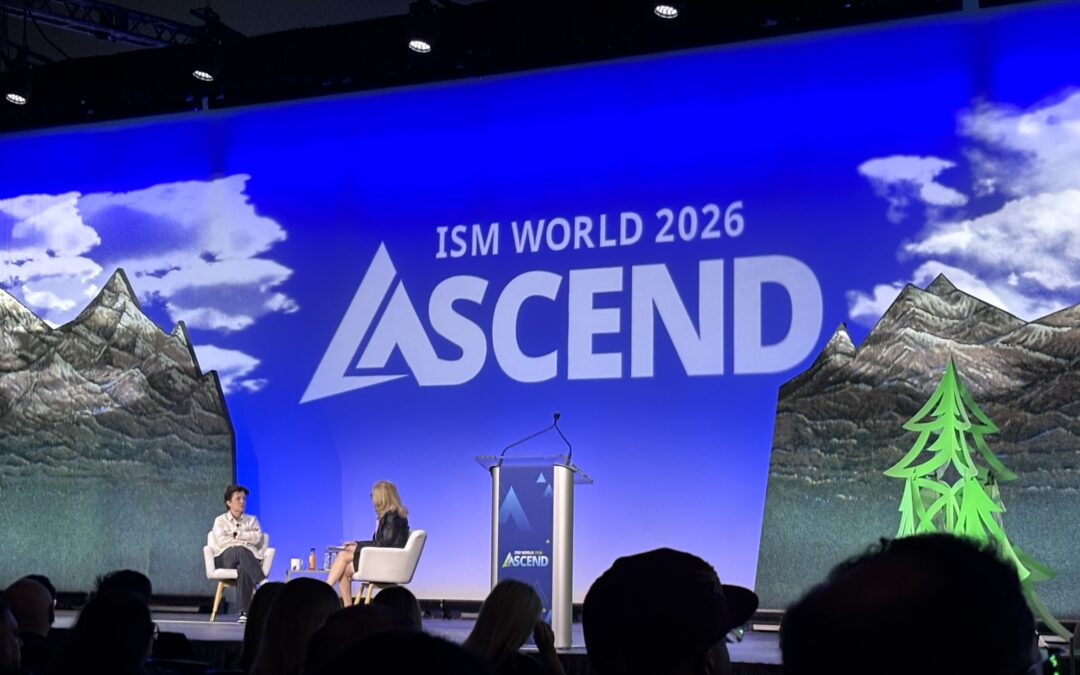
Conference season is in full swing! Do you have any good ones on your itinerary? When I was in charge of a team, I used to task team members who went to conferences with coming back and presenting what they learned to the group. We didn’t go to many conferences at the companies I worked for, but it was always a good development exercise to do a report out. In that spirit, today’s report is for the Institute for Supply Management conference (ISMWorld) 2026. While the keynote wasn’t as good as Kevin O’Leary (Mr. Wonderful) last year, Kara Swisher was a fascinating speaker who spoke about the tech world and what we should all be doing about AI. I also watched a good session on Orchestration vs. Source-to-Pay (S2P) tech and another on the traits of a strong negotiator. Today let’s review my notes in the spirit of a “report out” for those who could not be there.
Kara Swisher
Kara Swisher is a bestselling author, Wall Street Journal and New York Times tech writer, and leading podcaster. She has a dry, acerbic wit and is one of those people who will “tell it to you straight” instead of performing. She talked a lot about AI, which she generally feels is underregulated and pulling our society in the wrong direction.
Ms. Swisher started out talking about how large companies still dominate tech, are driven by revenue, and are only barely watched by the government. There are currently no real regulations on AI, and money is buying a continued lack of governance via lobbyists and high-powered lawyers to defend lawsuits. Ms. Swisher noted that the President who pushed back most against AI was Biden, but he didn’t do so very strongly or well. Her summary of this situation was to quote an old proverb: “‘When elephants fight, only the grass suffers.’ We’re the grass.”
The current AI landscape is like the early days of the internet, where CEOs say, “Let’s use this tool” but can’t answer the question “For what?” This made me think of my article about how AI looks a little like the early days of e-auctions, where people are recklessly using a tool and not realizing the consequences of using it poorly. One of the quotes that keeps echoing through my head is that Kara Swisher said, “People won’t get run over by AI. They’ll get run over by people who can use AI better.” Yikes. What a terrifying thought, and I think she’s right. It makes me think that the difference between Gen Z and Gen Alpha will be whether they learned AI or are AI native the way the difference between Gen X and Millennials is whether they learned the internet or grew up with it.
Kara Swisher did talk about a few examples where AI has benefitted humans instead of companies or profits:
- Someone programmed dolls to respond to conversations and older people were able to use these dolls for social connection.
- Exoskeletons help people walk who are otherwise unable to do so; the addition of AI to the programming makes the false skeleton much better than programming or remote controls alone.
- Ms. Swisher was able to meet and help “train” a synthetic version of herself. She said when they started, the AI version was a bit rough. But after an hour or two of talking to it, the AI version was much closer to herself. She lost her father when she was young and wished she could talk to a version of him, even a very imperfect one. An AI version of herself would let her great grandchildren know her, at least a little.
So what do we do about AI and the new world we’re increasingly stepping into?
- We need to redo our antitrust laws. They haven’t really been touched in more than 100 years and simply don’t serve the modern era. We are surrounded by ungoverned monopolies.
- Similarly there need to be privacy regulations on what AI is allowed to do with all the data we feed it. I’ve definitely seen this already in which chatbot/LLM companies are using and how they are choosing to build company-specific versions to protect company confidential data. Yet individual consumers currently have no privacy protections on our data.
- We need to make companies pay for job retraining when they lay off workers due to AI. I thought this one was particularly interesting and potentially hard to govern, but I do like the idea. Companies should pay for job training to allow workers replaced by AI to build new skills, but they won’t do so unless required.
- Our public officials need some pressure to enact these changes and make regulation catch up with the current tech world. This doesn’t just mean “call your congressperson,” it means large companies with power need to use their money and influence to pressure Congress to enact these laws. Those of us in leadership positions in large companies can use that power to see this done.
- Raise non-isolated children. Ms. Swisher emphasized this most of all, saying “The people who are causing the most harm in the world weren’t hugged enough as children.” I have a fridge magnet my son recently quoted to me from the National Museum of African American History and Culture that says “It is easier to build strong children than to repair broken men.” – Frederick Douglass. This is so true and is something all of us with children can strive toward.
While this keynote was not focused on supply chain, ISM 2026 was another conference with HUGE focus and chatter on AI. Therefore it made sense that the keynote was focused on AI’s impact on the world more than on something more specific to the supply chain profession and Kara Swisher was an excellent and engaging speaker.
Source-to-Pay vs. Orchestration
The next session I made it to was about source-to-pay (S2P) software vs. orchestration software. Synertrade was representing S2P, and Tonkean was representing orchestration. It was structured as a debate between the two, but really stayed quite friendly.
Side note: I really wish orchestration software had been a Thing when I was taking on my VP of supply chain role. While it existed, it was in its infancy. Orchestration software would have helped me pull together seven separate teams in three different countries so much better.
First, both platforms discussed the use of AI in their software.
Source-to-Pay use of AI:
- Language translation
- Supplier compliance (checking certificate expirations, etc.)
- Predictive risk – pulling together data on likely disruptions before they happen
Orchestration use of AI:
- Intake flows using natural questions (i.e. “I want to gather spend across all our ERP systems on the MRO category)
- Workflows and answering simple questions (as well as engaging a human when the AI didn’t know. I wish more AI did this…)
- Agents performing repetitive tasks
S2P is a system of record while orchestration handles messy work between different stakeholders. If S2P is a factory, Orchestration is the control tower.
The debate continued by focusing on the most valuable part of the solution.
Source-to-pay’s most valuable offerings:
- Synertrade specifically is an S2P with one code base across all modules (sourcing, contracts, supplier relationship management)
- Ease of use for supply chain practitioners
- Integrated data from the ERP system, Dun and Bradstreet, catalogs/punchouts, etc.
Orchestration’s most valuable offerings:
- Control
- Process clarity and moving through workflows
- Compliance with the process and guiding users to the right process
Lastly, both platforms talked about lessons learned from implementation. S2P noted that implementation has to be the right balance between decision by committee and stakeholder collaboration. Teams have to have buy-in, but decisions can get stuck in committee forever if we’re not careful. Part of good implementation is taking stakeholder input but not letting them have control over the process. Orchestration pointed out that implementations should prepare for exceptions and how those will be handled as they appear. They also pointed out the importance of not overbuilding implementations and understanding that they won’t be perfect initially. Launch, learn, and then iterate.
Negotiation Seminar
The last seminar I was able to get to was on traits of a strong negotiator with Shawn Malone. I’m just going to lay out his eight traits here, with some basic explanation added. This was an interesting seminar, but I found it to be a little surface and I never like when the example used for a room of procurement professionals is negotiating the purchase of a car. Yes, we all buy cars. But that negotiation looks completely different than the one we face with suppliers every day. So when I teach negotiation, I try to use examples like pumps or factory expansion projects because those are closer to what a procurement negotiation looks like.
- Set high aspirations – “anchor” the other party closer to your number to start, and try to make your anchor just on the edge of what is reasonable. It’s hard to bring a seller’s initial price down significantly or a buyer’s initial price up significantly once stated.
- Position your case advantageously – describe what you’re buying or selling in the best possible light. For a buyer, this might be talking about potential future business opportunities or how important this business is to the buying company.
- Manage information skillfully – ask more questions than your negotiation partner, and guard what would give the other party more leverage.
- Satisfy needs over wants – you know something is a want if it is specific or states a “what.” Needs are more flexible and are more about the “why.” There is one way to meet a want, but often multiple ways to meet a need.
- Know your power – power is the ability to influence outcomes. If you think of yourself as powerless in a negotiation, you are. And you will behave, think, and speak like you’ve already lost the negotiation.
- Concede according to plan – Have an out and a way you’re going to concede points, don’t make concessions without getting something for them, and don’t posture so strongly you can’t back up without shame.
- Look at overall value – this is the classic “total cost of ownership” I’m always talking about. Supply chain is about value, not cost. Sticker price is only a piece of what something costs a company.
- Embrace tension – every negotiation has inherent tension, so be ready for it and embrace it instead of trying to avoid it. Use it to anchor your numbers and “pull” toward that anchor, and keeping tension helps maintain leverage. A tensionless negotiation is one where no one cares about the outcome.
I hope some of my “notes from the field” are useful if you either couldn’t make it to ISMWorld this year or if these are seminars you couldn’t attend. I would love to see you at ISM in Washington, DC next year! If you’d like to talk about conferences, AI, procurement software, or negotiation, let’s chat. If you’d like to get these articles weekly straight to your inbox and never miss one, sign up for my newsletter.
My book, Transform Procurement: The Value of E-auctions is available in ebook, paperback and even hardcover format: https://www.amazon.com/dp/B0F79T6F25
My chapter in the powerful anthology Femme Led: Hard-Learned Lessons from Women in Leadership is now available in ebook and paperback format: https://a.co/d/0bOzma8F