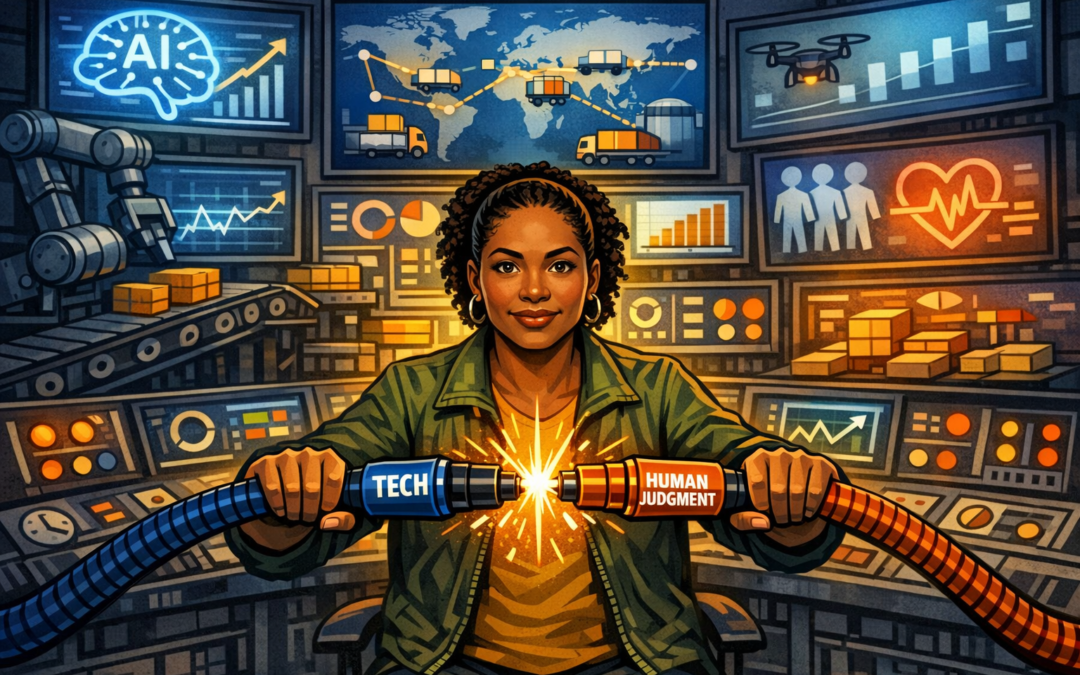
I love the Iowa State Voorhees Supply Chain Conference, and not just because I’m an alumni. People who attend this one-day conference are there to learn, not just to rub elbows and eat good food (although the catering is very good). When I was primarily in corporate roles, it was extremely difficult to attend supply chain conferences and keep my skills up. So today’s article I’m going to cover my notes from the conference, my impressions and how it relates to things I’ve seen, and generally try to bring you along as my virtual guest to this event (without having to travel or spend a day in a meeting room). If you get a moment, let me know if this is useful and helpful as I have several other conferences this season I can do this with and have done it in the past with ISM and ProcureCon.
Supply Chain 5.0 and Supply Chain Transformation at Casey’s
I was very in and out of both of these first two sessions due to other calls, but I wanted to capture a few things from them.
In the Supply Chain 5.0 talk, Mr. Stanton noted there have been five industrial revolutions:
- The age of machines
- The age of standardization
- The age of computers
- The age of connectivity
- The age of human values
The Supply Chain 5.0 is: Resilient, human-centric, and sustainable. One of Mr. Stanton’s points was that in the world of AI, the future is human. This was a thread I heard throughout the day and that I’m starting to hear more and more. Perhaps I’m a bit biased as I’ve already written about the balance of humanity and AI, but it seems like the conversation is shifting a bit away from “What this tool can do for us?” and more toward “How will humans use this tool best?” We’ll see if that theme continues at this year’s ISM World conference in Denver in a week.
I missed even more of Doug Means from Casey’s Convenience Stores, but caught that they used Relex Solutions for predictive inventory. For each store, store managers or buyers were spending significant time planning what to order and were still experiencing both seasonal inventory surges and shortages on the key items they needed. They had to roll out predictive inventory a bit slowly and get the inventory ordering to “mostly right” before they could make big progress. They built momentum once they could show that store managers weren’t making many tweaks to the system recommendations. I think this is a fascinating area of improvement, and while it’s a bit of a situation where you can replace the word “AI” with “Computers,” it’s certainly a useful application of technology.
Startup Showcase
Next up every year is a small showcase of startup businesses that serve the supply chain. First was Grant Stanley with Bulldog Works, LLC. Bulldog Works creates podcasts with the goal of recruiting and retaining truck drivers. They’ve found the pipeline in trucking is that drivers will listen to podcasts aimed for them, then they will watch non-hiring videos, and then they will seek thoughts from ChatGPT or seek out the recruiting company. The point was that truck drivers have a lot of windshield time and they don’t want to spend their downtime cruising the internet for a new company to drive for. But they will listen to a podcast. This was a fascinating presentation because the undercurrent was the eternal wisdom of going where your audience is. This is true in trucking or any other area where you’re trying to reach people.
The second startup was Veer Juneja with Fleetline. This company optimizes drivers and driver loads, essentially matching drivers to loads. I confess this speaker was clearly very smart and talked very fast, but I followed very little of what he said. Logistics is my weakest supply chain pillar, and he was pretty deep into the weeds of programming and algorithms. If you’re looking for startups to keep an eye on, this guy is worth following. When he figures out how to translate his message for the audience and dials in what he’s doing, he’s going to be unstoppable.
PechaKucha (“Chit Chat”)
My favorite part! This is such a highlight of the conference for me, and is when a few of the supply chain professors at Iowa State rapid fire share highlights of their research. They only get seven minutes and I find it interesting what they’re choosing to study.
Bottom Line: OEMs can still profit from offering repairs
Dr. Denizel studies e-waste and conducted a study of the interest/tolerance of consumers for the cost of repairs for cell phones and refrigerators. She found a common set of curves graphing the consumer willingness to pay for repair and the cost for repair, simplified here:
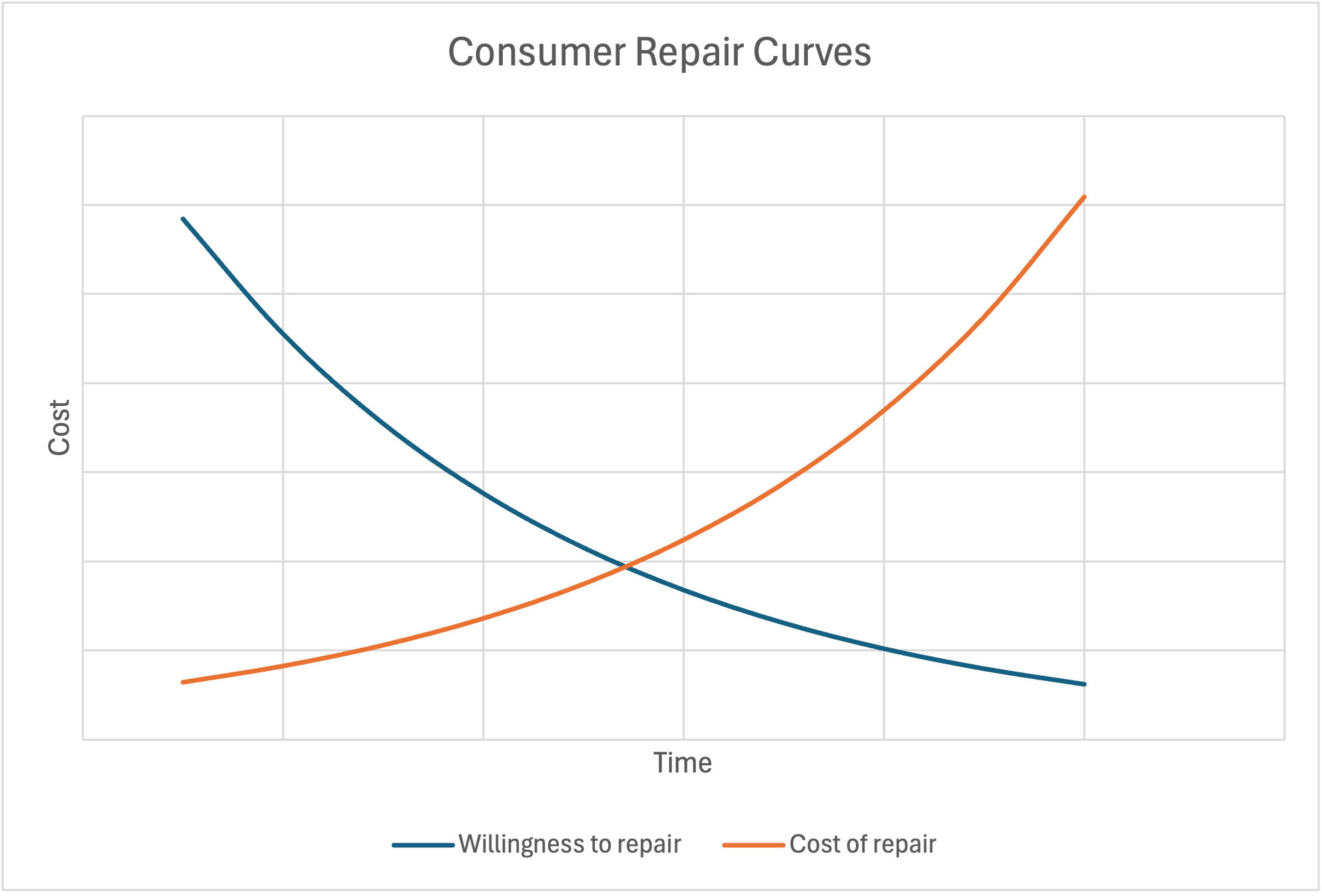
For a $1200 cell phone or a $1500 refrigerator, those curves both cross at about $425. For the cell phone, the time scale of the full curve is about 3 years and the fridge is about 11 years. I thought this was interesting, but her research was a little removed from real world applications. She didn’t consider “cannibalization” where consumers repairing instead of buying new causes an OEM to lose sales, and there were a few other factors she didn’t consider (such as the fact that most consumers don’t actually pay $1200 for their phone).
Bottom Line: Foreign Trade Zone value is in shareholder value, clear boundaries on goods, and better policy lobbying.
Dr. Ralston is one of those people who can really speak well and hold a room. He spoke about tariffs and specifically Foreign Trade Zones (FTZs), with a clear emphasis on value. He started by noting the value of tariffs to a government, which include:
- Raise revenue for the government
- Protect domestic industries
- Providing leverage with another country about a non-trade issue
He also highlighted the three ways for companies to deal with tariffs:
- Change the source country to one not tariffed as heavily
- Tariff engineering (changing manufacturing process, evaluating alternate tariff codes)
- Foreign Trade Zones
He’s just beginning more in-depth research into this, but he noted a few benefits of FTZs. If you’d like more info on what an FTZ is and how to use it, I have a past article on the topic. Benefits include:
- Better inventory management, which increases cash flow and yields a better stock price
- Clearer boundaries on value and how much of a good’s price goes to tariff
- Better ability to lobby for FTZ policies. If large or many companies use FTZs, they are better able to help set more beneficial policies around them.
This talk wasn’t in very much depth, nor did it have specific research around it, so I look forward to next year when he has more research to show.
Bottom Line: Comprehensive personnel insurance can have unintended consequences for Uber and Lyft
Dr. Pal looked at what happened when Uber or Lyft provided comprehensive personnel insurance (health insurance) for their drivers. Surprisingly, providing insurance actually had major unintended negative consequences for the companies. After providing insurance, the platform that provided the insurance saw a productivity decrease of 6% and saw their competitor’s productivity increase by 5% (no, I didn’t get those backwards). I’m not quite sure why this is under the supply chain umbrella, but the findings are interesting and real-world applicable. It would be interesting to see if this same effect happens in other “gig economy” jobs.
Bottom Line: Food regulations mean holding more finished goods, which means less time on sale shelves
Dr. Grover is studying the impact of food regulations (specifically the Food Safety Modernization Act) on the food supply chain. He noted there are more than 200,000 food safety regulations that apply to an ounce of beef from farm to fork in the US. He found that food compliance costs after the FSMA increased by $150m overall and represent up to 6.2% of the costs for a small firm. Due to these changes, the food industry is holding more finished goods for longer, which means a larger percentage of the shelf life is spent on warehouse shelves than consumer shelves.
I have mixed feelings about this one as a local farm owner. I understand the need to keep our food safe, but it’s also true regulations can be a measurable part of food production costs. Our farm primarily pays those costs in the form of warehouse/freezer licenses and higher processing fees to get our meat state-inspected for resale. That also means we drive our beef over an hour away to get a locker with the appropriate inspections.
Project 61
The presentation by Mark Manera from Project 61 was my unexpected favorite of the day. Project 61 is a nonprofit focused on truck driver health, where 61 is the average age expectancy of a truck driver. That’s 16 years earlier than the average American and is largely based on the sedentary lifestyle truck drivers lead with a very mentally and physically demanding job. Project 61 has a free app that provides resources specifically for truck drivers on how to eat well at truck stops, exercises to do in the back of a cab, and just generally meet them where they are. They can pair with corporations to help them tailor benefits packages that actually help truck drivers, and really work hard to figure out what will and won’t work for the driver.
I learned a lot from this presentation because I’ve never really dug into this part of supply chain culture and knew very little about it. Mark was also an incredibly engaging speaker, with just the right mix of story and fact to credibly interest the crowd. His was a masterclass in how to do this kind of public speaking.
The Last Mile is Human
The last speaker of the day was Mark Baxa from CSCMP. He emphasized that we have optimized most aspects of the supply chain except for the human. Machine supply chains are very efficient, but they are also extremely brittle. We’ve seen this play out in recent world events and are continuing to see all the places a machine-led supply chain breaks. This echoes back to Mr. Stanton’s notes about humanity in AI, and Mr. Baxa noted that humans are able to think, lead, adapt and decide while machines simply cannot (yet). He emphasized the need to develop the people in a supply chain instead of relying on machines, and that resilience comes from adaptive humans running intelligent systems.
I agree with Mr. Baxa that humans are where a supply chain succeeds or falls apart. I find myself mentoring the supply chain or procurement team members in every client I help, one way or another. I even had a client hire me specifically to mentor a supply chain leader new in her role. Of course, I thought this was a very worthwhile investment! Joking aside, we simply can’t get so excited about AI that we build brittle supply chains that break the minute geopolitical pressures rise.
If you’d like to talk about conferences, humans and AI in supply chain, or any other topic, let’s chat. If you’d like to get these articles weekly straight to your inbox and never miss one, sign up for my newsletter.
My book, Transform Procurement: The Value of E-auctions is available in ebook, paperback and even hardcover format: https://www.amazon.com/dp/B0F79T6F25
My chapter in the powerful anthology Femme Led: Hard-Learned Lessons from Women in Leadership is now available in ebook and paperback format: https://a.co/d/0bOzma8F