
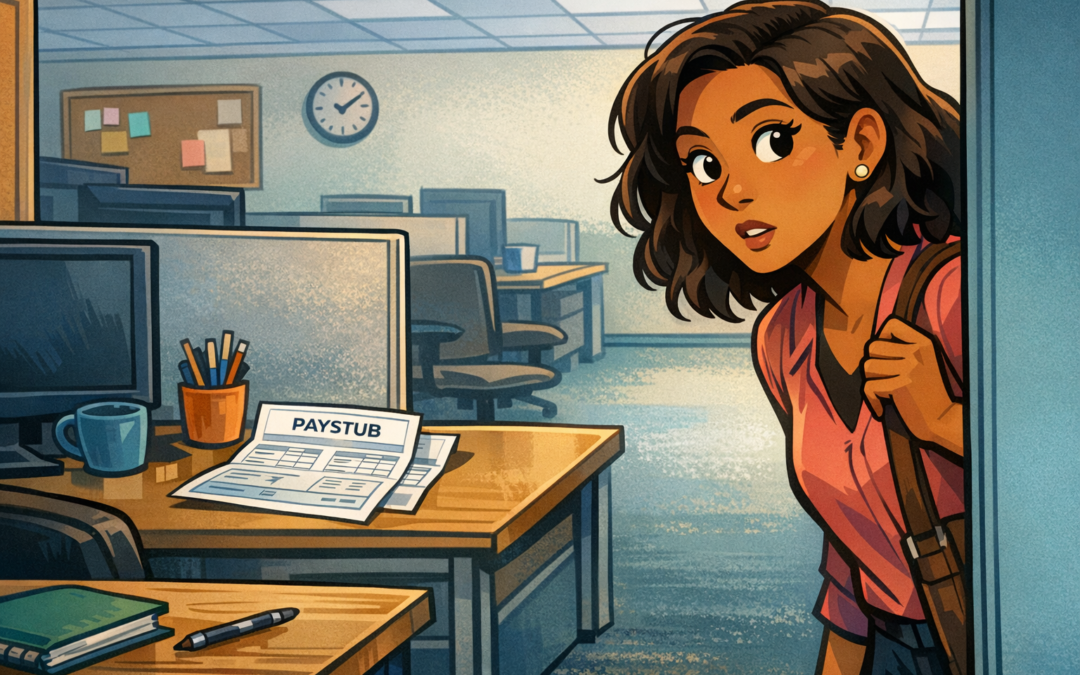
I came back early from lunch on a Friday afternoon and there it was, sitting on the desk next to mine. An already-opened pay stub. From the new Design Engineer we had hired two months prior. No one was around, everyone was still at lunch or in the workshop. I knew I shouldn’t look at it, but I couldn’t resist. With a small pit in my stomach I stole a glance at my colleague’s pay stub. He made $250 less per year than me. Two hundred and fifty dollars per year! Both of us had one internship with this company before joining it. We were doing the same job in the same group. But I had a Master’s degree in Mechanical Engineering and a double undergraduate major, he had a Bachelor’s in engineering. And I had joined the company two years before; he was fresh out of college. The year was 2010, not exactly ancient history. Those two prior years were rough for the economy and had a lot of pay freezes, but that $250 stung. If our genders were reversed, would he be making significantly more? I know if he was, the justification would be that he had more experience and a higher degree. I’m highlighting this story because this week is Equal Pay Week in the US. And because every female professional I know has a variation on this story, whether they’ve been working five years or thirty. Today let’s talk about Equal Pay Day, what you can do about it, and bonus: today is the day the anthology Femme Led I wrote a chapter for releases. So I’ll talk about that one too!
Equal Pay Day
Equal Pay Day is a “holiday” that marks the day when women are paid the same amount as men for the previous year, and is on March 26th this year in the US. This means the average woman has to work from January 1 to March 26 to make the same amount the average man made from January 1 to December 31. It is worth noting that this date is the average for all women, women of color typically have a later date (black women are July 21, latinas are October 8, and native american women are November 19!). Some countries also instead mark the day when women are essentially working “for free” until the end of the year based on the gap, typically in November. If the US calculated this way, women would be working for free from October 8th until the end of the year.
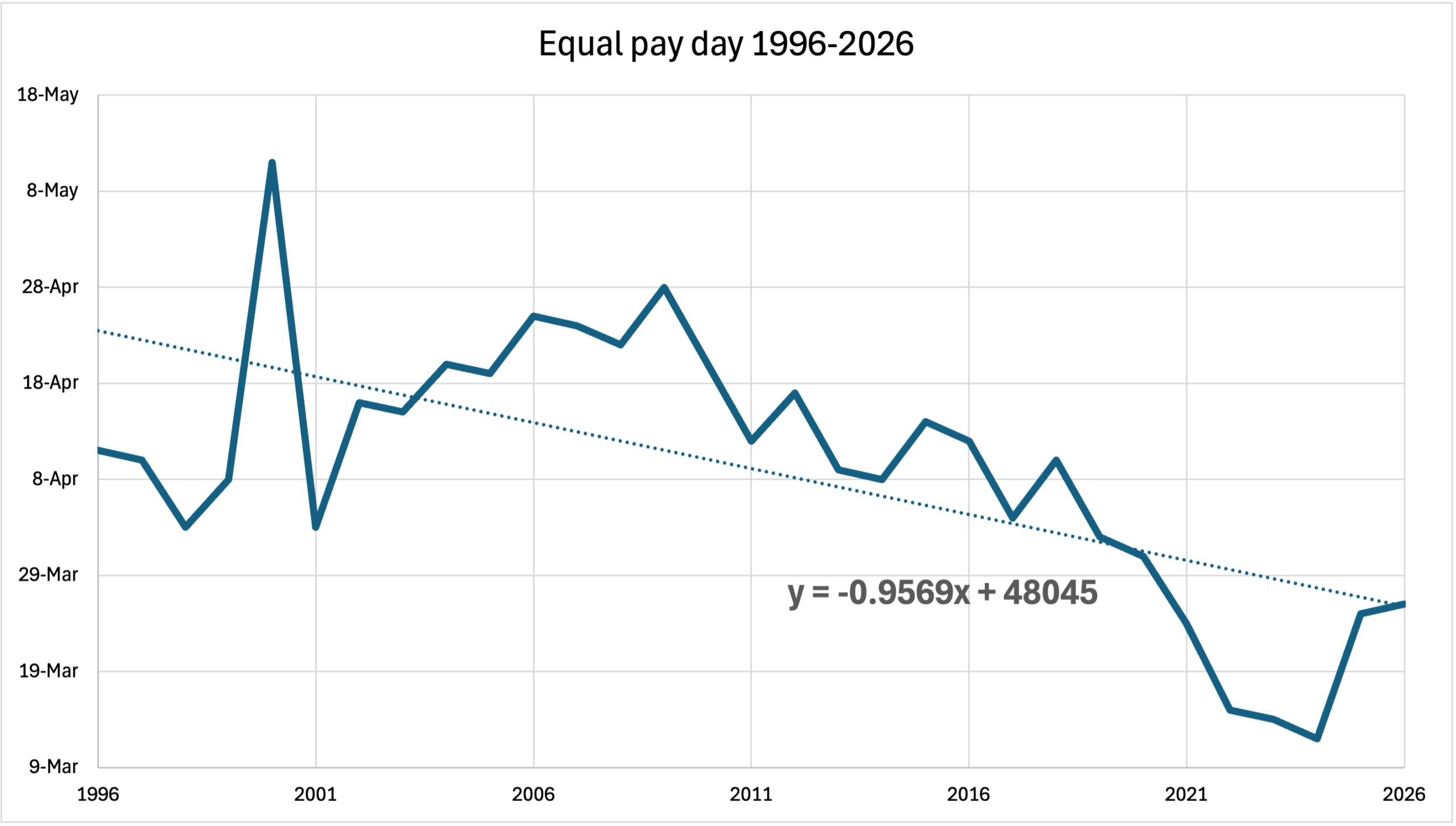
Until recently, COVID-19 helped push this trend in the right direction, with a notable improvement in the gap between men and women for 2021-2024. Yet somehow, we are right back on trend now. It makes me wonder how much this is due to the labor shortage during that time or is where return-to-office mandates are showing up. The equal pay day calculation doesn’t adjust for anything at all (age, education, number of children, even number of hours, etc.), it’s a very absolute, unadjusted number. While that can make it controversial, I personally like it unadjusted. It highlights the fact that men typically hold higher-level, higher-paying jobs. And anyone who is saying “women have less experience than men” seem to forget that women have been a major part of the paid workforce since at least the 1980s. There’s a whole career’s worth of experience between then and now, so I’m not buying it. Most procurement teams I’ve worked with have had more women than men in buyer and senior buyer roles. But as soon as you get to a category manager role or higher, that ratio flips. At conferences, the vast majority of procurement leaders I meet are men.
I will note I went looking for the graph on this article and didn’t find it, so I had to create it. If we continue on its trendline, we will make it to equal pay in 2037, eleven more years from now and more than forty years from when it was first calculated. That is more than the length of an average professional career.
What You Can Do as an Individual
I know it’s easy to feel powerless to help close the pay gap, regardless of your own gender. However, there are things you can do at any level.
- Consider talking about your salary with trusted co-workers. I know, this feels incredibly awkward and taboo. That’s how the gender pay gap persists. Studies have shown that when companies publish salaries, the gender pay gap shrinks by 7%. That would mean Equal Pay Day this year would be March 1. Still not equal, but lots closer. If you’re male and you discover your female colleagues are making less (especially with similar job responsibilities and similar or more experience), don’t just go home and feel smug. Say something to your boss. Say something to HR. Support your female co-workers and their choice of actions. We women need your voice to amplify ours. Don’t talk over or take over for your female colleagues, but don’t stand by silently either.
- Negotiate your salary. Yes, this is super hard. I do find procurement professionals tend to be better at it than most because we literally negotiate for a living. We now have access to incredible amounts of information on what salaries should be by location, position, education, and a million other factors. Use a “should-cost analysis” to determine reasonable pay, not historical data. This also goes for promotions and continuing to advocate for yourself once you’ve joined a company.
- If you’re leaving due to pay inequity, do it a little loudly. Be respectful because you never know where life will take you, but consider gracefully making it known that you’re leaving because you’ve discovered a notable gender pay gap. I regret not doing this when I left the company in my opening paragraph, because I’m quite convinced they still fight a wide gender pay gap at that business.
What You Can Do as a Manager
If you have the privilege and responsibility of leading others, you may have just a little more freedom to help with the gender pay gap, even if only within your team.
- Review your people. In my very first role as a manager, the first thing I did was compare salary and experience levels within the same job classes across the team. Even though my company’s HR team paid for an outside service to do the same every year, I rapidly discovered all of the women on my team were paid less than their male counterparts. I brought my data to my boss, who was surprised that this was true. He was a good boss and worked with me to correct it, although it took longer than I wanted it to because of corporate bureaucracy. Don’t just take HR’s word for it, do your own analysis.
- Ensure your company has the outside tools to evaluate the wage gap. I’ve run bids for services to review wage rates and compare them to outside labor, and they are fairly reasonably priced. Even for a big company, I found those services/softwares to be in the five-figure range annually. While these services are not infallible (see bullet point one above), they can be helpful. Even if your procurement team doesn’t typically source HR services, see if those procurement skills can help in this space.
- Advocate for your people. Especially if you run a small team, consider working with other managers to ensure gender pay equity across the department. If someone comes to you about pay gaps, listen and don’t just assume “HR’s got this”. Yes, it’s hard. Yes, it’s awkward. It’s also the right thing to do.
Femme Led: Hard-Learned Lessons from Women in Leadership
It’s not a coincidence that this anthology of women in leadership is releasing during equal pay week. As one of the authors, I’ve had the privilege to read this book before it releases and it is so good. I swear I’m not just saying that. It’s full of so many interesting and powerful stories from the 15 other women who contributed, and I will let their own words speak for them instead of trying to do it myself. Here are my favorite quotes from each chapter as a taste of this awesome anthology:
Introduction—Stephanie Mikulasek
“Leaps happen when we stop overriding ourselves.”
- The Leadership Leap: A Dialogue—Sierra Melcher & Stephanie Mikulasek
“There is nothing that needs to be fixed within you. Nothing. You are whole and complete in who you are.”
- How Resiliency Drives Purpose—Catalina Escobar Bravo
“I’ve learned that leadership begins with listening, deep, uncomfortable listening. Listening to context, to people, to what is actually needed, not to what we wish were true.”
- Despite The Fear—Carol Britton
“Remember that fear is a natural part of any significant change. Embrace it, use it as a driving force, and never let it hold you back.”
- A Spider Web in a Storm—Anna Dravland
“Not because I ‘powered through,’ but because I finally allowed myself to accept help: medical help, emotional help, community support, and the kindness of strangers and friends.”
- Becoming Brave—Tracy MacDonald
“Show up, find your voice, and take up space because you deserve to be here.”
“There will be times like that, when you are overwhelmed and unsure of the next right step, but just show up anyway. Just write it down, look it up, and figure it out, one step at a time.”
- Corporate Entrepreneur – My chapter – 7 concrete things I’ve learned in two years on my own
- I Beg You To Differ—Diana Frank
“It’s not serving a client to just do what they ask for. And the good ones know the difference.”
- Grit-to-Grace—Dr. Katherine Humphreys
“You don’t always climb the mountain because you want to; you climb it because you need the view from the top to be taken seriously by those standing on the peak.”
- The Epidural Blinded Me—Donna Marie Marino
“A Director is a title I have—not the woman I am.”
- Fire That Bitch—Jean Smarto
“Fire That Bitch –Stay true to your core values even when it is hard.”
- Abandoning the Script—Michelle McCartney
“A woman’s strength is in her soft surrender. The surrender of comfort, the surrender of control, and the surrender of expectations.”
- The Un-Abandonable Mission—Asya Dimitrova
“I spent years in deep focus, memorising society’s scripts so I could give adults what they needed to see from me in order to make them feel safe, which in turn allowed me to be myself when I was alone.”
- The Power of Saying Yes—Tiffany Harris
“The vision we have of ourselves is only half of what it takes to live the life of our dreams.”
- Investing in Art: An Impactful Way to Grow Your Money—Ann McCreath
“[Art is] more than just a decoration on a wall; it’s a living energy, a higher vibration, which permeates the space.”
- Beyond Transactions: The Art of Giving in Business—Alexandra Yung
“True giving is rooted in selflessness and free of any agendas and expectations.”
If you would like to talk about gender pay gaps in your world or being part of a book anthology, let’s chat. If you’d like to get these articles weekly straight to your inbox and never miss one, sign up for my newsletter.
My book, Transform Procurement: The Value of E-auctions is now available in ebook, paperback and even hardcover format: https://www.amazon.com/dp/B0F79T6F25
My chapter in the powerful anthology Femme Led: Hard-Learned Lessons from Women in Leadership is now available in ebook and paperback format: https://a.co/d/0bOzma8F