
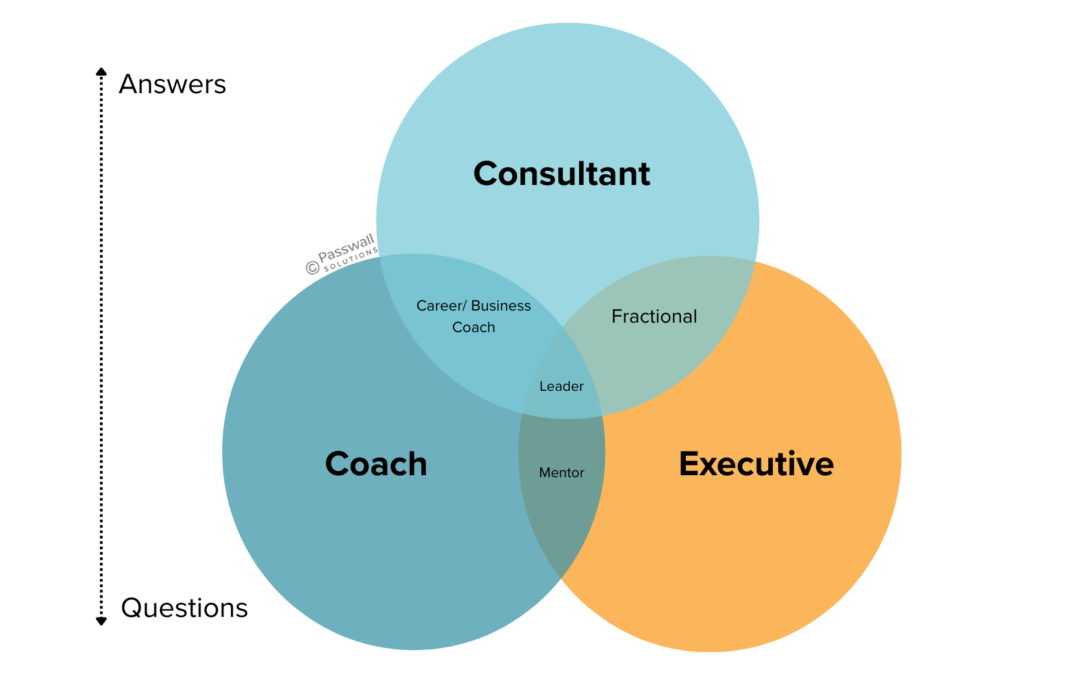
The roles we all play matter, and so do our names for them. I’m not talking about the roles of mother, sister, wife, buyer, etc. I’m talking about the professional roles of Consultant, Executive, and Coach. While there’s a lot of overlap between these three roles, their differences are defined by something simple: questions and answers. Today I’m going to explore the roles of Consultant, Executive, and Coach, how they fall on the question/answer continuum, when someone might step out of their core role, and the consequences of crossing boundaries between roles.
Consultant
My current role is Consultant. That role still makes me cringe a little when I say it out loud, because for so much of my professional career “Consultant” was a dirty word. In many companies, it still is. Ultimately, a Consultant is someone who uses their specific expertise to help others. In the framework of questions and answers, a Consultant has the answers. Whoever hired the Consultant was looking for a specific set of skills, expertise, and experience, and a Consultant’s answer to the question “How do we . . . ?” should generally be “I’ve done that before, and this is how we do it.” This doesn’t mean Consultants know everything. We definitely don’t. It also doesn’t mean the exact same answer will work for every company. It won’t. It does mean a Consultant should have the experience, framework, process, etc. for solving the problem efficiently and smoothly.
Side note: This is where the large consulting firms sometimes trip up if they don’t put enough experience on their support teams. They have the frameworks, the benchmarking, and the data to solve a problem. But often the big consulting company’s team lacks expertise and experience to be more than a Contractor.
A Consultant often steps into a more Coaching role when they’re helping a client implement a major new project, process, or team. I’ve been more of a Coach when I’m helping start up an e-auction center of excellence, intensively meeting with a team daily to help work through emergent issues and all of the nitty-gritty details they face as a new team. A Consultant becomes an Executive when they’re serving in a more fractional role, where they’re a part-time Executive for a company not yet ready to hire someone full time or working through a leadership transition.
The danger of a Consultant taking on a strong Coaching role is that they may not really be qualified as a Coach. There are certifications for Coaches for a reason, and I’ve seen Consultants who thought they were Coaching well when they really weren’t. It should be a temporary role and should fit within the Consultant’s larger scope of work. Moving beyond a Consultant role is a recipe for scope creep, in which no one really understands who does what and often there is significant resentment on both sides without clear conversations. A Consultant who takes on an Executive role is also very open to scope creep beyond their contracted tasks/projects, and can cause resentment among the Executive leadership team. A Consultant is, by definition, an outsider to a company. If they take on too much of an Executive role, the other executives start to feel like someone who doesn’t really understand or have a stake in their business is telling them what to do.
The primary danger with a Consultant overstepping their role is resentment.
Executive
An Executive is a senior leader within a company, typically someone who reports to the President or CEO or in large companies perhaps two levels below the CEO or President. Sometimes that President or CEO is also included in the Executive Team, sometimes they are considered to be separate. I have been an Executive at a large company before, and Procurement by its nature tends to interact with all levels within a business from front line up to CEO. An Executive has the right questions, and the best Executives already know the answers. One of my mentors often says, “I never ask a question I don’t already know the answer to.” At this point, he has been an Executive for almost thirty years because he became a VP before he was 30 years old. Once I learned that about him, I started paying better attention to his questions and realized most of them have the goal of helping those around him see his point of view. This is not to remove diversity of thought, but instead to increase organizational alignment. Not everyone can know the answers the way he does, but the mark of an Executive is having the right questions and not letting the answers be a surprise. (I might argue a middle manager is marked by asking good questions, but often being surprised by the answers.)
A good Executive who leads a team is always coaching. This is probably the largest role overlap, because a truly great Executive develops the people around them. The consequence is if an Executive spends all their time coaching, they don’t have the bandwidth for strategic leadership, which is their core work.
Side note: If your Executive isn’t coaching, developing, and helping those around them, consider switching teams or roles if you can. This is especially true if you’re ambitious (that’s not a dirty word!) and want to be an Executive yourself someday or simply want to keep growing in your career.
A time an Executive might take on a more Consultant role is either toward the very end of their career (read: maybe the last two years before retirement) or if the business is in a major crisis where the Executive has relevant experience. Like a leader during a war, the answer can be for a person with the answers to simply provide those answers and get through the current disaster. The disaster might be a new market disruption, bankruptcy or other internal instability, or a natural event. I suspect during COVID a lot of Executives suddenly became Consultants within their business, I certainly saw it happen.
An Executive who falls into a Consultant role is in danger of losing their business authority. If an Executive always has the answers, they often start to take on a “my way or the highway” attitude and cease to be part of the executive team. Other Executives start to view them as an outsider (because they’re acting like one!), which undermines their role and takes away from their ability to provide strategic direction to the organization.
The primary danger with an Executive overstepping their role is losing focus on strategic leadership.
Coach
I have the least personal experience as a Coach, having never had it as my primary role. That being said, a Coach is someone who is there to guide others to being the best version of themselves and performing at their maximum ability. Similar to an Executive, a Coach has the right questions, but does not have to know the answers. Sometimes when coaching, neither the Coach nor the person receiving coaching actually know the answer, and the act of asking the question starts an introspection process or never truly requires a stated answer. The goal in coaching is development and growth, not the answers to questions.
A Coach might move into a more Executive function when an organization needs to develop its people, especially those at or just below the Executive level. I typically see this in Human Resources or Training Executive titles, unless a particular team is really struggling to have a strong talent or leadership pipeline providing future leaders. Similarly, a Coach will serve in a Consultant role when a clear development outcome is needed. Like with the Executive role, a Coach who takes on more Consulting has to be careful not to become an outsider to an organization (if they aren’t already outside the organization) and must maintain their authority. They also need to avoid scope creep where they start to be responsible for hard deliverables and lose focus on developing people.
A Coach who moves into an Executive function might take a while for the impact of that role boundary violation to show up. Unless the Coach can move more fully into an Executive role, the Coach will struggle to set strategic direction. Due to the nature of coaching, a Coach might also have trouble holding their team accountable for solid results because they are more accustomed to development and growth being the full outcome of their efforts. A Coach who takes on a Consultant role might struggle to have enough answers instead of good questions. Unless the goal/project of a Consultant is personnel development, the Coach’s questions and the Consultant’s answers are inherently opposite. That being said, business and career coaches both live at the intersection of the Consultant and Coach roles, where development is the full and desirable outcome of the engagement.
The danger of a Coach stepping out of their role is getting in over their head and being responsible for delivering more than personnel development and growth.
Front Line
In any organization, Consultants, Executives, and Coaches are only a minority of the personnel. Many people are on the front lines of the organizations, or individual contributors. I feel a need to mention this role briefly because if you’ve read many leadership theory books you might be asking, “But doesn’t the front line also provide answers? Does that make them all Consultants?” I agree the Front Line is much more responsible for answers than questions, but the difference is that the Front Line is tasked with finding the answers instead of simply already knowing them. This is why I typically classify Contractors with the Front Line instead of classifying them with Consultants. I know that may offend some Contractors, but a true Contractor is in an organization to deliver results, find answers, and supplement that organization’s personnel. In contrast, a Consultant is there to lead an organization through their framework, process, or solution to solve a key problem. I certainly know people who classify themselves as Consultants but are doing the work of a Contractor and vice versa, but this is how I make that distinction.
If you’d like to talk about your roles, your organization’s roles, leadership, or anything else, let’s chat. If you’d like to get these articles weekly straight to your inbox and never miss one, sign up for my newsletter.
My book, Transform Procurement: The Value of E-auctions is available in ebook, paperback and even hardcover format: https://www.amazon.com/dp/B0F79T6F25. My chapter in the powerful anthology Femme Led: Hard-Learned Lessons from Women in Leadership is now available in ebook and paperback format: https://a.co/d/0bOzma8F
This post was written entirely by me and not by AI. The article summaries, title, and graphic may all have used AI to assist/generate ideas/edit, but the article content is fully human.