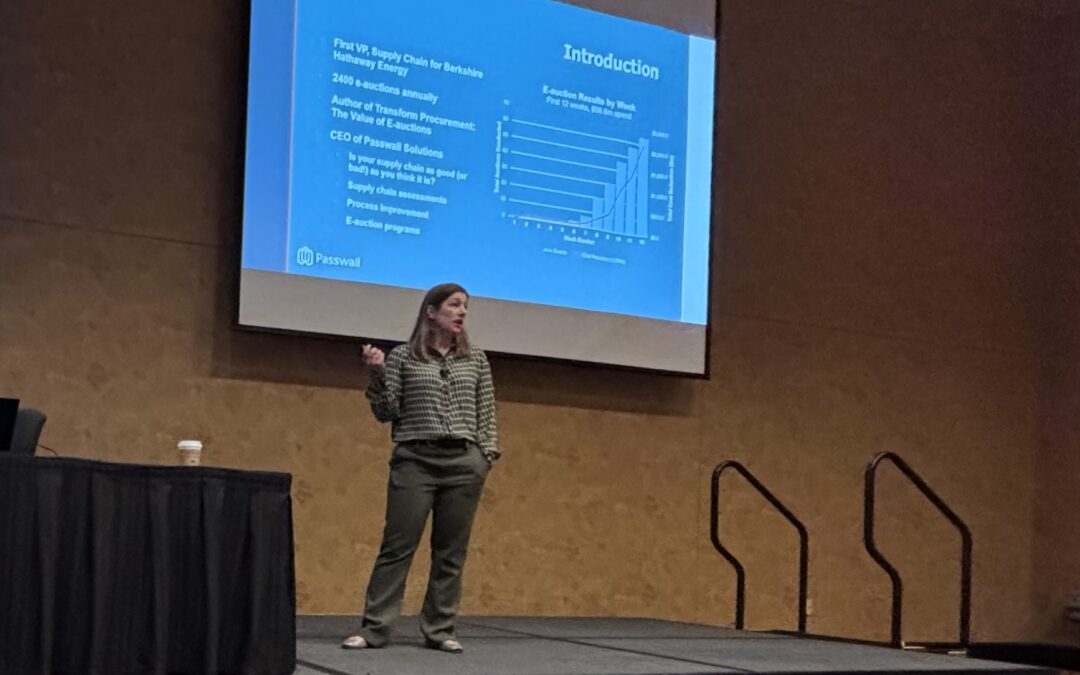
It’s conference season again! I feel like I say that a lot on these notes, but that’s because twice a year it’s true. I had the privilege of speaking at the ISM Twin Cities conference last week, which is an excellent conference where the ratio of procurement professionals to sponsors is not out of balance the way some conferences are. Speakers were interesting and engaging, there were enough attendees to represent a lot of different perspectives, and there was an intimacy to the event that allowed me to get to know people. If you can get there, I highly recommend attending (MSP is a very nice airport if it’s a plane flight for you).
I ended up presenting in the first conference slot, so I’ll start this summary right after my talk. I had to leave halfway through the second day to make it to my daughter’s swim meet, so I’m afraid I missed those talks but I’ll put their topics and link to their speakers at the end of the next post so you can follow up if you’re intrigued. Today I’m going to share my notes from the first three talks I attended, as I wrote this up and discovered it was WAY too long for one post. I’ll cover what the speaker said, what the speaker’s points mean for practitioners, and my thoughts on each speaker’s points as part of the current procurement landscape.
The 6-step Strategic Sourcing Flywheel with Sam Jenks from Kodiak Hub
Sam Jenks from Kodiak Hub talked about creating flywheels in our business, loosely based on the work of Jim Collins. He started with a metaphor about currently living in “dog years” with the speed that everything is moving. Six months in the world of AI is like ten technology years, because from 2024 to 2027 we’re rapidly going from simply understanding AI to scaling it. Our AI landscape is like planting a tree: the best time to start was yesterday, but the second best time is today.
So how do we get moving at the speed of life/AI? Build a flywheel. Unpackaged data is noise, so you’ll probably need some data to craft your flywheel. Here are the steps:
- List your replicable successes – what were your major wins, what do you consistently do well?
- List failures & disappointments – where have you fallen short or consistently produce disappointing outcomes?
- Compare and Extract Insights – Ask: “What do these reveal about possible flywheel components?”
- Sketch the flywheel – draft your loops of 4-6 steps in your flywheel, where every step drives and reinforces the next one.
- Simplify & consolidate – reduce your flywheel to 6 or fewer steps if you ended up with more
- Validate / stress test – run your successes and failures through your flywheel. Did it hold up? Refine.
- Align with the Hedgehog concept – does your flywheel align you with what you’re passionate about, what you can be the best at, and what people will pay you for?
An example flywheel he presented also followed the Plan-Do-Check-Act process and represented his steps for supplier management:
- Segment suppliers and shape category strategy
- Assess relevant supplier risk and conduct due diligence
- Negotiate contracts, onboard and qualify the right suppliers
- Audit quality, track performance and analyze spend
- Correct, develop and innovate with the best suppliers (then go back to 1)
What this means for practitioners: Sometimes we forget that our procurement/supply chain microcosm can function like a mini-business. What I mean by that is that you don’t have to build a flywheel for your whole company, it’s ok to build one for just your team. I do think it’s harder than these steps imply, and I would have to practice a few times before I got a flywheel that I thought actually accelerated my team. Even the exercise of “here’s what we do well, and here’s what we don’t do well” is valuable in a procurement team because it forces us to think about our internal customers and what they actually value. Flywheels are the path to supply chain maturity because every time we go through the cycle, we make our organization a little better and a little more sophisticated.
My thoughts: Sam’s thoughts on AI remind me of the conversation I had about AI, BI, CI and DI (article here), where we are going from Artificial Intelligence to Business Intelligence to Cognitive Intelligence and will eventually land on Default Intelligence. His flywheel also made me think of my Supply Chain 360 framework, which violates several of these rules (it’s too complicated), but has that cyclical nature. It’s definitely true that we build on our previous work to move our businesses forward. When we’re in that cycle, it’s hard to see progress, but if we’re doing it right we can look back and see progress.
Leveraging AI for Strategic Procurement & Innovation with Jim Leske and Kyle Lambert from 3M
3M is an organization with a history of innovation, but in recent years they’ve had to work to refocus on that core value. As part of this refocus, Jim Leske and Kyle Lambert have been working to build an internal Supplier Navigator tool for 3M suppliers to better help 3M engineers innovate. Jim and Kyle opened by noting that AI can build efficiency, but it cannot own the supplier relationship. They also spent some time talking about the innovation continuum, which has evolution (just fix it) on one end and revolution (breakthrough ideas) on the other. The tool they’re building is intended to have suppliers populate what they could provide to 3M to innovate in addition to what they’re currently providing.
There was also some interesting chatter about the 3M culture. One of their early innovators William McKnight said “If you put fences around people, you get sheep.” The procurement team has applied this thinking to an approved supplier list, saying an approved supplier list per category can stifle innovation.
What this means for practitioners: The 3M team shared three great AI prompts they have found helpful that you can implement today in your own system, so I’m sharing them here:
- Every Monday, brief me on market and trade developments affecting our procurement of minerals.
- Summarize these suppliers’ most recent 10-Ks, including average Days Sales Outstanding and where payment-term extension requests are reasonable.
- Where is our pricing out of step with the value we deliver, and which suppliers could provide ingredient substitutions to enable Value Add/Value Engineering?
The angle about approved supplier lists causing people to be sheep is really interesting and leads me to the question: Where do you have sheep that you don’t want sheep? I would argue that for an organization not founded on innovation or even seeking it, approved supplier lists are incredibly important and very valid (utilities, anyone?). But if you have an R&D team or a team tasked with doing more leading-edge work, consider giving them a slightly looser rein on their approved suppliers.
My thoughts: The audience was especially engaged with this presentation because it came from practitioners going through the journey instead of a sponsor or sales team. The presenters were reasonably candid with the challenges they’re running into and were bullish on AI without being unreasonable about what it can and cannot do. I honestly had never thought about an approved supplier list stifling innovation, but it’s a point worth noting. That’s especially true if your procurement team struggles to be a trusted partner and is continually at odds with technical teams.
What Great Negotiators Do Differently with Deborah Reynolds from Red Bear Negotiations
This is a solid session from Red Bear Negotiations by Deborah Reynolds, going through a mock negotiation involving purchasing a vintage Pontiac. However, I stepped out because I attended their session at ISM World on the same topic (article here) and didn’t feel like it was fair that I “knew the trick” to this negotiation already from that session. I will say what I said in that article: I don’t like the example of purchasing a car as a negotiation training for procurement professionals. Buying/selling a car for oneself is a negotiation and one most of us will encounter, but it’s a very different negotiation than for a factory expansion or purchasing manufacturing components. When training procurement professionals, I prefer to train on examples as close to what they’re actually purchasing as I can.
Economic and Commodity Update for 2027 from John Anton with S&P Global
This was a crowd favorite for sure and incredibly full of useful information. If your business has an S&P Global license, it’s expensive but also valuable. John Anton called this his swan song as he is retiring before next year’s conference, I will be sad to see him go. As he said at happy hour later, his theme was it will get worse…unless it gets better. I will try to share the trends the presenters called out here without sharing their proprietary charts:
- Even up to September 2026, S&P Global was predicting oil prices softening. Now they’re not predicting a “return to normal” on oil prices and traffic through the Hormuz strait until the end of 2027.
- Everything is up from a year ago; lumber (10%), steel, fiber, rubber, chemicals, and nonferrous metals (all 20-30%), freight and energy (50-60%) and computer chips (specifically DRAM, 580% – not a typo, that’s 580%).
- Data centers are driving everything. Construction everywhere and in every sector is down except for data centers. They are the only source of growth. Inflation and high interest rates are starting to cause those data centers to push out their timelines.
- Refined oil is carrying a higher premium over crude oil than historically, partly driven by the wartime destruction of middle east refineries. Refined oil used to track about $2 per gallon over crude, now it’s $3. We are currently already above peak forecast for diesel at $6.30 when it was predicted to peak at $6.00/gallon.
- El Niño is adding risk everywhere, including industrial/agricultural commodities, energy, and logistics (which is pretty much everything). This is throwing us toward stagflation.
- Freight is high due to global conflicts (worldwide shipping), weather patterns, and high fuel prices. It’s expected to come down some, but there’s a lot of risk in that prediction.
- Demand for skilled trades is driving wage growth, but basically only in the skilled trades that build data centers. Plumbers, electricians, roofers, steelworkers, etc. are commanding premiums due to demand.
- Steel is expected to go up even more in 2027 until we get some domestic production ramping up more toward the middle/end of the year. Stainless steel is also elevated due to tariffs because there is actually an oversupply of stainless in Asia.
- Watch out for the Midwest Premium applied to deliveries to Canada factories because that premium now includes tariffs (it used to be just freight). Don’t let suppliers charge the Midwest Premium for Canada.
- Supplies for electrical equipment are still really short, causing all utility supplies to be expensive with long lead times (my utility clients are already super aware of this one!). Electric utilities are still dealing with 3-5 year lead times for high voltage equipment.
- Ethylene and Propylene are expected to start falling and continue falling through 2028.
- Copper is high and not coming down any time soon. The 15% tariff hitting January 1, 2027 and additional 15% on January 1, 2028 are going to hurt badly. Because of these tariffs, speculators are literally stocking warehouses with copper to try to make a buck when tariffs hit and it’s causing strain on supply.
- Aluminum is about to come down, wait to buy or lock in contracts.
- Usually there is an economic slowdown following an oil price shock. “This time is different” because of the data centers propping everything up.
What this means for practitioners: Obviously understanding commodity markets usually has a big impact on our negotiations, so understand which commodities are most relevant to you. That being said, keep an eye on when those markets come down and make sure that suppliers reduce pricing as quickly as they were to raise them. If possible, make any commodity premiums (gas, steel, freight) into a separate line item so you can get them removed when they’re no longer relevant. This also keeps them out of your purchase price variance calculations. Consider making a part number for a freight premium or steel premium so you can then track which suppliers are charging it and how much they’re charging.
My thoughts: This was the most directly applicable session in so many ways, and getting it at a conference makes it much more accessible than the cost of an S&P Global license. The news wasn’t good, but at least it was realistic. I continue to think data centers are a bubble, and it scares me. I think the bubble bursts when public sentiment turns so far against data centers that they have to cancel projects or when they realize they’re overbuilt for current demand and overleveraged.
If you’d like to talk about flywheels, AI’s role in procurement, or how to leverage/mitigate commodity price spikes, let’s chat. If you’d like to get these articles weekly straight to your inbox and never miss one, sign up for my newsletter.
My book, Transform Procurement: The Value of E-auctions is available in ebook, paperback and even hardcover format: https://www.amazon.com/dp/B0F79T6F25
My chapter in the powerful anthology Femme Led: Hard-Learned Lessons from Women in Leadership is now available in ebook and paperback format: https://a.co/d/0bOzma8F