
So your CFO/COO/CEO has told you to go find value in your supply chain, and they probably mostly mean savings. You might not have the infrastructure to run e-auctions (although if you want to run a couple without having to purchase software licenses, drop me a line), and you might not have the skills in your team for a complex negotiation. Where to start? Many companies, especially those who are earlier in their supply chain maturity, have some key process opportunities that would bring value in the form of savings, cash flow, and/or delivery improvement. Let’s look at some of the places to find value in your supply chain, with real world examples of what those opportunities look like “in the wild.”
Opportunities and First Steps
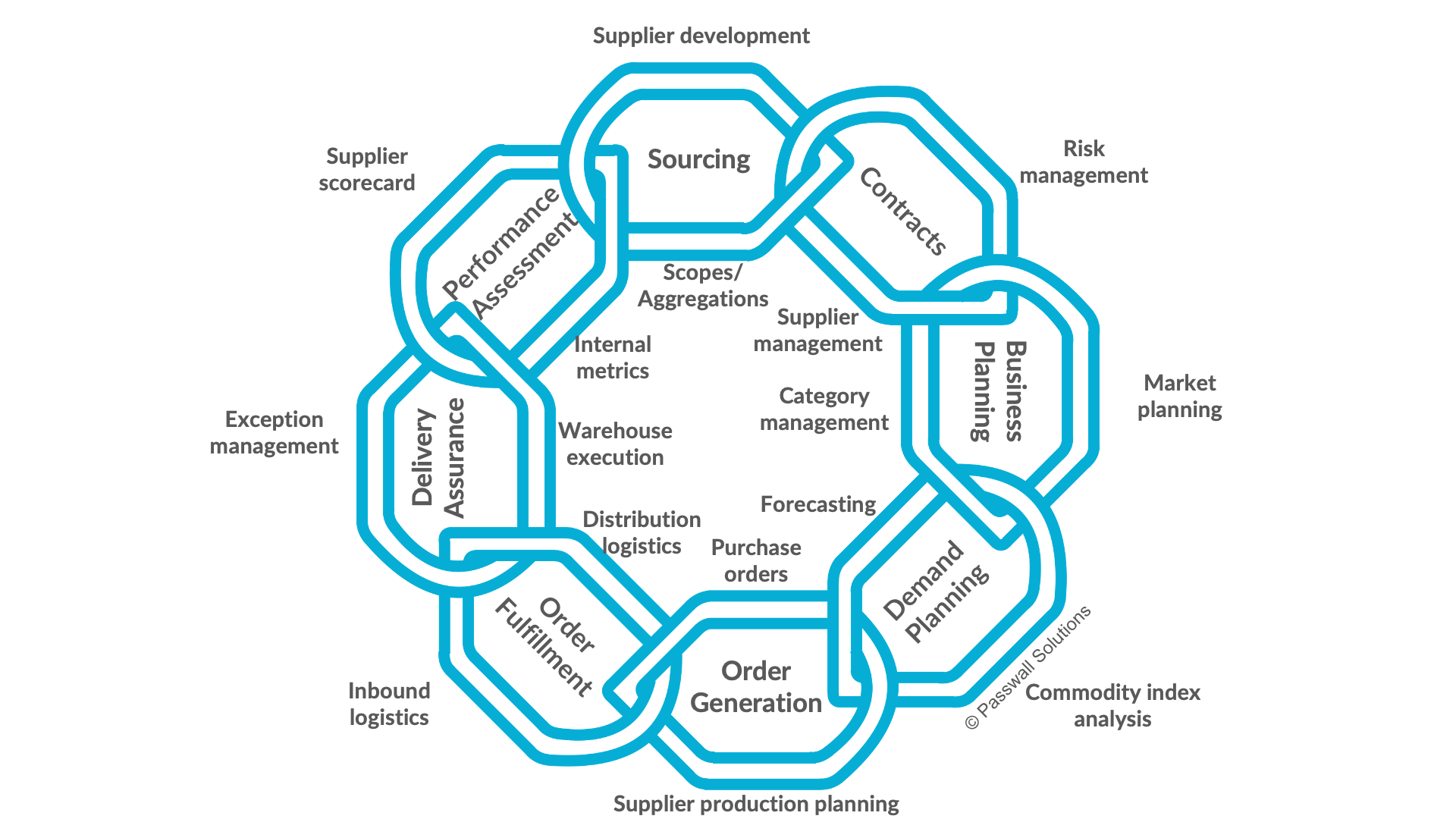
I know, this graphic/framework is kind of a lot. Blame my inner engineer. The core of this supply chain process framework is the links: Sourcing, contracts, business planning, demand planning, order generation, order fulfillment, delivery assurance, and performance assessment. Then each link has an internal-facing and an external-facing dimension that defines and supports it. When I’m assessing a company, I use this framework to help show strengths and opportunities and then help companies understand where the opportunity lives in the supply chain.
Going through this chain link by link, here are real-life examples and their opportunities, starting with Sourcing:
Sourcing – Supplier development: Finding and qualifying new suppliers, having right-sized supplier pools for each category (usually 2-5 suppliers)
Supplier development opportunity example – a small machining manufacturer had a strong supply base for their steel and aluminum, but only one primary approved supplier for heat treating. Diversifying the spend toward a second supplier would increase leverage to reduce lead times on heat treat and potentially add some leverage with the primary supplier to reduce prices 1-2% while making their sourcing more resilient.
Sourcing – Scopes/Aggregation: Writing quality scopes of work that allow for true competition and working together with affiliated businesses or buying groups to increase leverage
Scope/Aggregation opportunity example – a custom special-project manufacturer had acquired another business a few years prior, but was still running two completely separate sets of bids and contracts even for common suppliers. Aggregating spend to reach new volume tiers with suppliers would save 2-3% on their common spend, in addition to strengthening relationships with those suppliers by becoming a more prominent customer.
Contracts – Risk management: Mapping 2nd and 3rd tier suppliers, supply chain resilience
Risk management opportunity example – a large midwest utility understood where their first tier suppliers were located, but when a hurricane hit Houston they did not realize all of their carbon dioxide was manufactured/refined in Houston. Mapping their supply chain would have eliminated the scramble for carbon dioxide needed to keep the plants running.
Contracts – Supplier management: Contracts beyond Purchase Order terms with key suppliers, spend concentration
Supplier management opportunity example – a metalwork manufacturer had 80% of their spend in only 4.7% of suppliers (six suppliers) with 36% of their spend with one supplier. In a larger company this might mean more leverage, but for a small manufacturer it only meant risk. Building spend with secondary and tertiary suppliers for the same categories decreases the risk of a shortage and might even increase competition to bring pricing down 1-2% if competed properly.
Business planning – Market planning: Timing bids and purchases to market changes, understanding the “pull” from external customers for products
Market planning opportunity example – an agricultural equipment manufacturer was only running bids and doing a make vs. buy analysis when a supplier would send through a price increase, usually because markets changed. When they started scheduling bids for categories, they saved 2-5% on those categories and built more strategic relationships with selected suppliers.
Business planning – Category management: Bidding and contracting direct and indirect spend by category instead of by department or incumbent supplier
Category management opportunity example – moving into category management is a huge milestone in supply chain maturity and allows for the shift from just cutting and chasing POs to strategic procurement. A window manufacturer implemented category strategies for one key category per procurement professional on the team and saved 2-5%. In addition, they developed their team members who were new to procurement and built a much wider understanding of their assigned category markets.
Demand planning – Commodity index analysis: Understanding the movement of global commodities and their impact on the business
Commodity index opportunity example – a precision machining manufacturer was only tracking commodities when one of their distributors would send them a commodity index report (cropped as they usually are to the timeframe that sends the message the distributor desired). Independently checking (and then contracting!) commodity indices would enable cost avoidance when a supplier comes seeking a 5% increase but the commodity has only increased 2% or even decreased in the time period since the last contract.
Demand planning – Forecasting: Letting suppliers know of upcoming purchases, with or without a full commitment to purchase
Forecasting opportunity example – an aerospace distributor offered volume discounts to their customer in exchange for forecasts, passing along the savings of 1-2% for blankets and volume commitments to their manufacturing customer, effectively lowering the risk for all parties.
Order generation – Supplier production planning: Securing production capabilities with key suppliers, with or without a deposit or downpayment
Supplier production planning opportunity example – a large eastern US utility struggled with large power transformer lead times increasing from 11 months to 48 months from suppliers still not recovered from the COVID-driven supply chain crisis. They secured production slots (some with a deposit, some without) for rough specifications 3-4 years out, sending refined specifications one year and again six months before delivery to effectively bring the lead time back down to one year.
Order generation – Purchase orders: Efficiently creating purchase orders (POs) to order goods and services
Purchase order opportunity example – an HVAC manufacturer had a requisition queue with requests dating back more than two years still pending, waiting for the operations team to tell them when to convert requisitions into orders. Creating a process to allow the system to drive orders based on a combination of demand and inventory (instead of manual orders) would reduce their too-high inventory and improve cash flow, alleviate frustrations from a purchasing team being told to “hurry up and wait,” and reduce manual errors in the handoff between operations and purchasing.
Order fulfillment – Inbound logistics: Efficiently securing supply of materials from suppliers to company warehouses
Inbound logistics opportunity example – a building material wholesaler/distributor was constantly ordering individual partial truck loads of materials delivered to their more than 300 warehouse locations. Moving to a consolidated third-party logistics (3PL) approach would reduce the number of shipments to track and unload in addition to reducing shipping costs from 7-10% of the purchase price down to 3-5% by coordinating and consolidating full loads.
Order fulfillment – Distribution logistics: Efficiently moving goods between company sites
Distribution logistics opportunity example – I don’t encounter this opportunity often because most clients I’ve worked with have one primary location. As an opportunity, this looks like constantly shipping packages between sites, or even touching one material multiple times at different locations. Coordinating inbound logistics to drop a full truckload of material at multiple sites or moving to a central distribution model (think: Amazon) are the efficiency opportunities here.
Side note: While I can spot when logistics is an opportunity, I’m not your gal to fix it because my bread and butter is procurement. I have multiple contacts who are truly awesome at logistics and if you need or want a referral, I’m more than happy to connect you.
Delivery assurance – Exception management: Identifying, locating, and expediting late deliveries
Exception management opportunity example – a small aerospace manufacturer had no alerts, tracking, or reporting for late deliveries. Creating a process (maybe even an automated one) to ensure orders were acknowledged with expected dates, verify if shipments were on track, and set parameters for when to expedite would reduce risk the production line stops and build a more proactive supply chain team. While it’s hard to put a dollar value on that certainty, many manufacturers put the cost of shutting a line down at 4-5 figures per day in costs while that line waits for parts. (Have you ever bought a commercial plane ticket for a part to fly strapped in next to an engineering technician? I have.)
Delivery assurance – Warehouse execution: Managing inventory at the right level to keep operations moving without tying up too much cash flow
Warehouse execution opportunity example – a harvesting equipment manufacturer was holding 140% of its annual spend in inventory after purchasing a series of smaller manufacturers and their inventory. The inventory on the shelves didn’t match what was requested by sales, causing a deadlock when procurement would tell sales they needed to sell what could be made with existing inventory before more could be purchased. Scrapping or fire-selling the 26% of inventory with no customer order or had not moved in the previous year would free up cash to purchase components to build to customer demand and fuel increased revenue.
Benchmark: I’ve found in my assessments that a “healthy” amount of inventory is about 33% of annual spend. Every company is different, but companies not struggling to provide material to production nor struggling with cash flow carry about that much in inventory.
Performance assessment – Supplier scorecard: Clear communication with suppliers about key metrics and improvement opportunities
Supplier scorecard opportunity example – a precision machining company struggled to have suppliers deliver on time and in full (OTIF), but then also couldn’t make the case to their leadership team that certain suppliers weren’t performing. Adding a supplier scorecard process would clearly document gaps, allow suppliers an opportunity to improve, and show the leadership team when a supplier needed to be replaced. Not to mention, the holy grail in procurement: improving supplier relationships through clear communication.
Performance assessment – Internal metrics: Measuring the supply chain on aligned metrics based on what moves the business forward
Internal metrics opportunity example – a small metalworking manufacturer was not tracking any supply chain metrics, and also had no staff members dedicated to procurement or purchasing (just warehouse). Tracking metrics would help the business understand and decide if they were large or mature enough for procurement/purchasing staff and how they would want to measure that staff for creating business value.
While many of these opportunities feel small, procurement is always a world of small percentages. One percent of a million dollars is $10,000. Many companies have quite a few categories with at least $1m in spend, and that savings adds up fast. A good procurement department saves multiple times their own costs through cost avoidance, savings, and increased value. A good warehouse and/or logistics department adds value by getting both inbound and outbound shipments delivered on time.
If you’d like to see some customized supply chain value opportunities for your unique business, let’s chat. If you’d like to get these articles weekly straight to your inbox and never miss one, sign up for my newsletter.
My book, Transform Procurement: The Value of E-auctions is available in ebook, paperback and even hardcover format: https://www.amazon.com/dp/B0F79T6F25. My chapter in the powerful anthology Femme Led: Hard-Learned Lessons from Women in Leadership is now available in ebook and paperback format: https://a.co/d/0bOzma8F
This post was written entirely by me and not by AI. The article summaries, title, and graphic may all have used AI to assist/generate ideas/edit, but the article content is fully human.