Qualifying new suppliers is one of those activities that seems like it should be easy, but is surprisingly hard. I’ve seen companies of all sizes and in all industries struggle with supplier onboarding, qualifying enough suppliers for a given category (but not too many!), and even supplier management in general. When we talk about risk management in procurement, a big piece of mitigating risk is getting the right suppliers on board and converting them from vendors to supplier partners. Today let’s talk about supplier qualification: global forces currently moving in the world, where new suppliers can come from, initial considerations for qualification, and benefits of really good supplier partners.
Global Forces
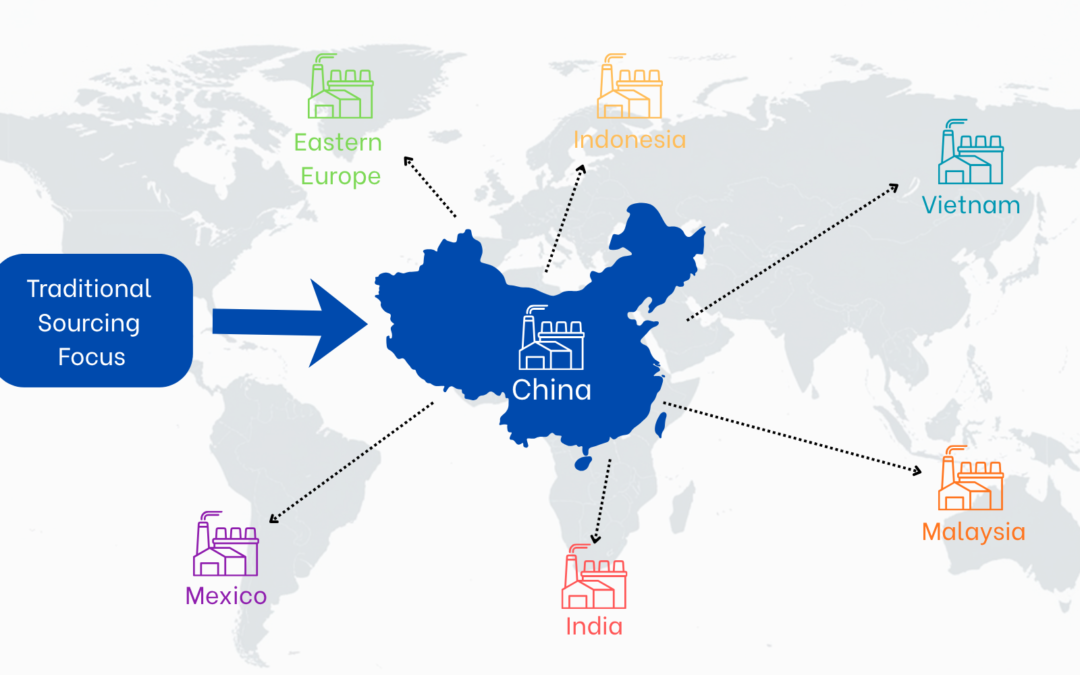
I recently had a client want to run a couple e-auctions as part of their supplier diversification efforts. They were looking to broaden their supplier market in a couple of key categories from China to more southeastern Asian countries (India, Indonesia, Malaysia, Vietnam, etc.). I worked with the Synertrade team and that client’s team to identify and qualify new suppliers and I was taken aback by how hard it was to find really good suppliers outside of China. I knew China has spent the last 40-50 years building infrastructure, training people, and generally becoming a manufacturing powerhouse (I mentioned it in my Apple in China review from DPW in this article). Yet this was the first time I’d really faced this juggernaut in my own career. Previous companies I had worked with and for either embraced Chinese suppliers or had already developed domestic suppliers and were willing to pay the premium for products finished in North America.
The bottom line is that countries like India and Vietnam will build the right level of manufacturing capability…eventually. They’re certainly working on it, but are not there yet. Just as we cannot simply turn the lights on in old factories in the U.S. and start manufacturing the way we did in the 1950s again, countries building new capabilities cannot simply put up a building and start operating at the level global customers expect immediately. It will take time to train a skilled workforce, build equipment large enough to handle things like 1-ton steel castings, and go through a couple of ISO audit phases to dial in a quality control program.
Sources of New Suppliers
One of the questions I ask in my Supply Chain 360 assessment is where a company finds new suppliers. The most common answer, especially for small companies, is definitely Google (or more recently, ChatGPT and Claude). I don’t have a problem with this answer, it’s often where I start when seeking out new suppliers and is a perfectly good place to start. It should not be the only answer, because search engines/LLMs will only get you so far.
The next most common answer I get for new supplier sources is from the company’s employees. Many procurement professionals have worked somewhere else previously and bring their supplier contact list along with them (or at least a stack of business cards). Much as everyone keeps trying to replace business cards, I’ve been grateful for my physical stack of cards multiple times. Supplier contacts can come from the procurement team, but just as often come from the engineering or executive teams. Don’t be too dismissive of a supplier just because they came into engineering first (but also build the kind of relationship with engineering that they bring you new suppliers sooner than the dreaded “cut this PO for me, I’ve already negotiated the price and terms” stage).
Side note: Something that took me way too long in my career to learn: when you get a new business card, after that person walks away, write the date and something about them on the card. This is true not just for sales, but any card you receive. When going through your stack later, it’s nice to know how old a card is and if there’s something about that person to help jog your memory later in case you need to reach out.
I have even seen companies hire procurement professionals for their contact list. This is especially true in startups, who are starting without an existing supply base and only the relationships built by the founder or investors. If you’re a procurement professional at any stage in your career, consider at least connecting via LinkedIn to your key sales reps, the ones whose email you currently know by heart and who respond quickly when you reach out. You’ll be surprised how fast those relationships fade if you go to a new company in another industry, and you never know when you might need that contact again. I wish I still had contact info for some of my early career contacts.
The last major source for new suppliers is a company that specializes in finding and qualifying suppliers, like ScoutBee or Tealbook. These supplier qualification programs are increasingly being acquired by larger companies like Coupa or SAP, and as of writing this, Tealbook has been almost completely subsumed into Supplier.io. Either way, if your company has the resources, these options can be a great way to get new suppliers and have someone else do the legwork of finding and qualifying them. In order to use these services, you have to first be clear on what makes a “good” supplier for your business.
Qualification Considerations
One of the things that surprised me when I started working with clients of all sizes was how many had very few formal or written supplier requirements. Even larger companies were very informal about their supplier expectations, with no clear understanding of which categories were high or low risk to the business or how their supplier mix affected that risk. If you’re looking to establish supplier qualifications, start with a supplier manual. My article on creating a supplier manual can be found here.
Consider your certification requirements, as third-party certifications can be a bit of an “easy button” on initial supplier vetting. Requiring ISO 9001 certification or similar environmental certifications like ISO 14001 can help weed out suppliers who aren’t yet mature enough for a rigorous customer. On the other hand, if you’re a company who can tolerate some risk, finding a new supplier who has just started and working them through their startup phase can be a great way to get exactly what you want while building a supplier relationship from the ground up.
Decide if you want to audit new suppliers, including if you want an in-person walkthrough of their plant. Especially in certain areas of the world, there are aspects to how a supplier runs their business you simply won’t know unless you walk through their space. While it’s cheaper in the short run to skip the audit and the travel that goes with it, that may end up costing you in the long run if that supplier isn’t able to deliver your expected quality or lead time.
Side Note: Don’t make it too hard for new suppliers to respond to your RFPs or otherwise work with you. It’s a balancing act between asking enough questions to qualify suppliers but not so many that you become a “difficult customer.” More on running a supplier-friendly RFP in my article here.
Benefits
The benefits to a strong supplier are numerous. I had a boss who once said there were two kinds of suppliers: complacent ones (meaning the incumbent suppliers) and those who were hungry for our business (new suppliers). He was generally in favor of constantly bringing in new suppliers who were willing to work hard to bring us value and earn their spot as a supplier. Incumbent suppliers do tend to simply raise prices over time, sometimes independent of what commodity indices are doing. Keeping new suppliers coming in both opens new opportunities and helps prevent incumbent supplier complacency. (Of course, a correctly-set up e-auction also helps get even your incumbent suppliers back to true market value and then you don’t have to deal with constant supplier turnover in order to keep your prices at market rates.)
Having multiple suppliers dramatically increases supply chain resilience. Even though the current buzzword in supply chains is “AI,” not so long ago it was “resilience.” If every supplier for a certain category is in Houston, Texas and Houston has a major hurricane, you’re in trouble. Keeping multiple suppliers for categories is extremely helpful in being able to pivot quickly and keeping supply moving. Keeping a good relationship with those secondary or tertiary suppliers also helps when your competitors suddenly need to pivot out of a certain geography.
To qualify a supplier and keep them qualified in an ever-changing environment, you may need to be more flexible and supportive than you expect. A good example of this is in cybersecurity. Having strict cybersecurity requirements is important, but you may need to give a new supplier time to implement your requirements (like a SOC 2 audit). I’ve written contracts with suppliers where they start supplying my business, but have 18-24 months to complete a SOC 2 audit and be in compliance with my standard terms and conditions. Be firm but fair if some of your supplier qualifications are in the “someday” category for suppliers.
If you’d like to talk about your supplier qualifications, or anything else, let’s chat. If you’d like to get these articles weekly straight to your inbox and never miss one, sign up for my newsletter.
My book, Transform Procurement: The Value of E-auctions is available in ebook, paperback and even hardcover format: https://www.amazon.com/dp/B0F79T6F25
My chapter in the powerful anthology Femme Led: Hard-Learned Lessons from Women in Leadership is now available in ebook and paperback format: https://a.co/d/0bOzma8F