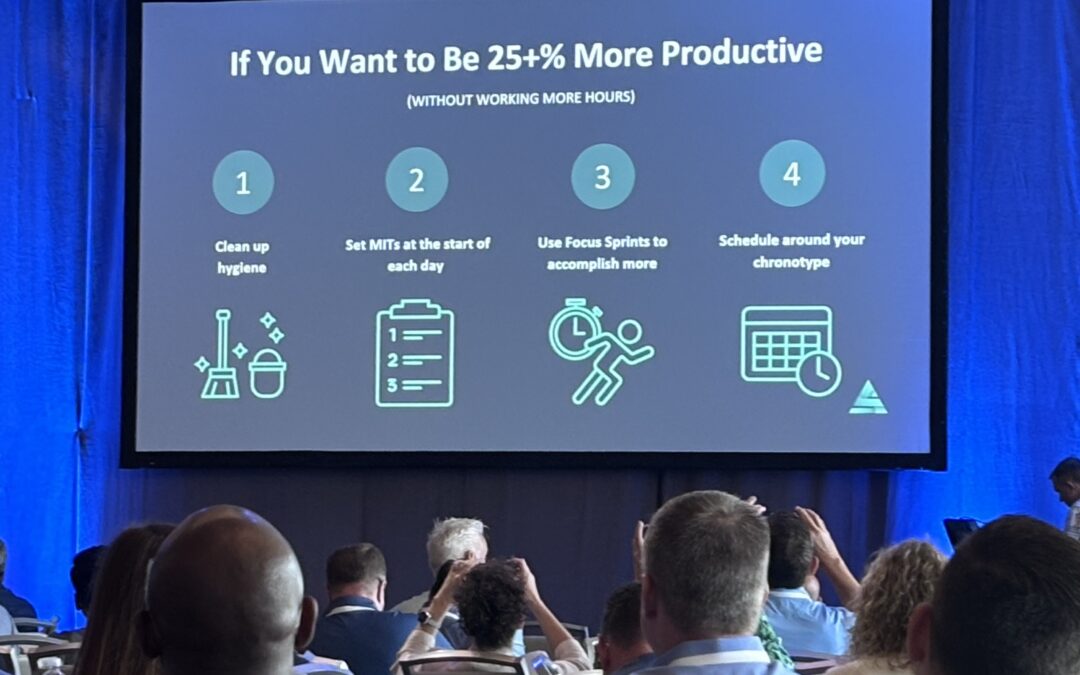
Welcome to part two of my notes from the Utility Supply Management Alliance (USMA) conference in Florida. If you missed the notes on a team’s success and on creativity, check them out here! Note they are NOT utility-specific or even supply chain-specific, and neither are today’s takeaways. Today we will cover Chris Thornberg from Beacon Economics on the state of the US economy and Sahar Yousef, neuroscientist on productivity (her talk was profound and devastating). Any one of these people would have been a phenomenal keynote on their own for any conference, and the combination of all four makes a solid impact (last week was Mike Massimino the astronaut and Duncan Wardle the creativity expert!). As with last week, I’ll be including the live illustrations from Matt Orley of Big Paper Strategy, who creates these awesome hand drawings to synthesize the ideas from the presentations. Let’s work through my notes from the second two talks, I know you’ll have good takeaways here.
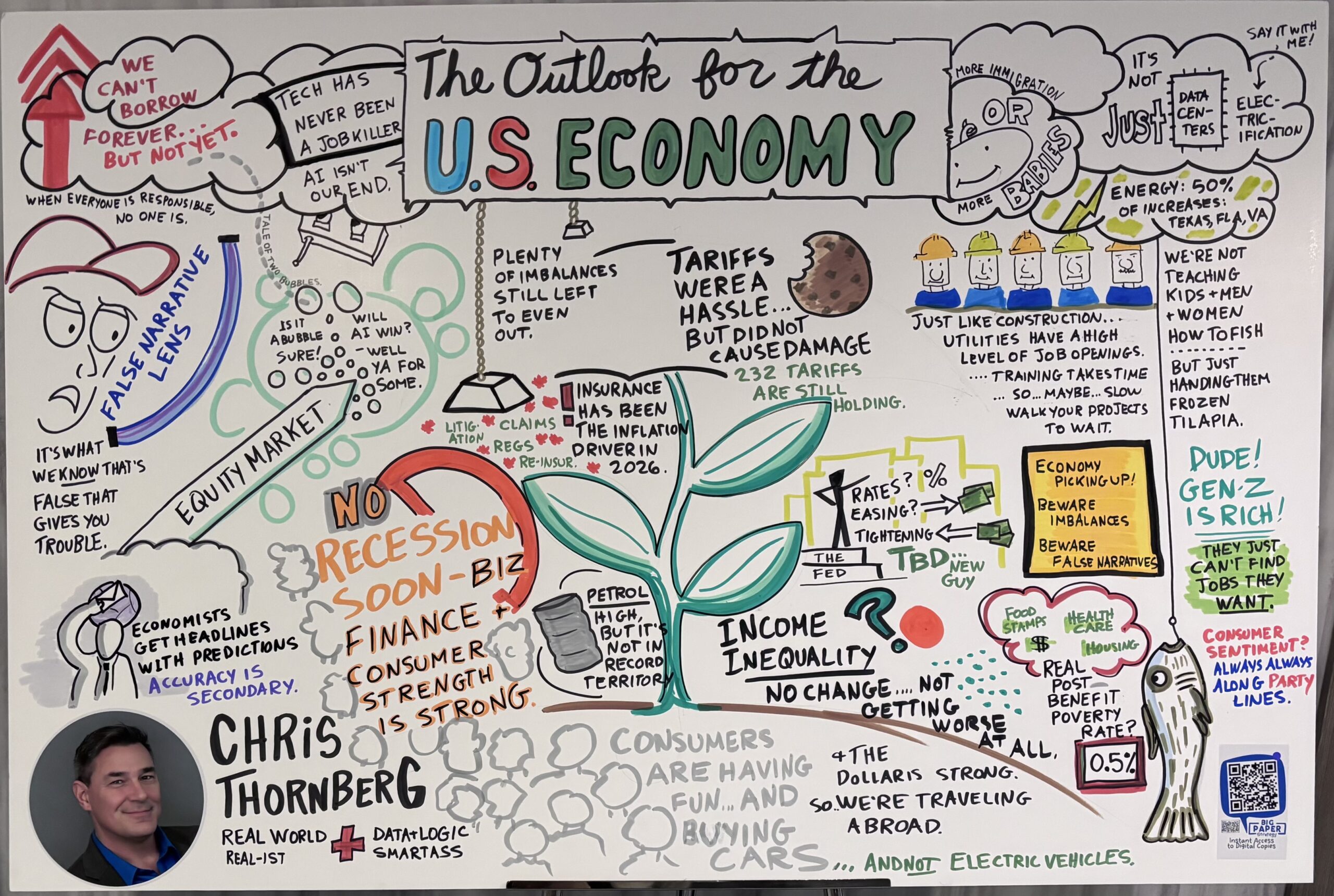
Chris Thornberg – The Outlook for the US Economy
Dr. Chris Thornberg is an economist and data researcher, specializing in the state of the US economy. His overarching point was that the US has two economies: the one in the social narrative and the economic reality. The social narrative is the story told in the media, our personal lived experience, and what we think is going on in the economy. The economic reality is what’s actually happening according to data, trends, and indicators.
In our current social narrative, the economy is struggling and so are people. Money is tight and politics dominates the story. That last one about politics is somewhat true, but the data shows the rest of the social narrative doesn’t match economic reality. Household and business finances are strong, people are buying cars and vacations, and 2025 was the first year we spent a larger percentage of our income on restaurants than on groceries.
Chris did note there were some strong downward pressures on the economy, including large public deficits (US government debt, anyone?), financial bubbles, and insurance as the largest contributor to household inflation. The US is dependent on global capital inflows, and we can’t fix a lot of these imbalances while the media narrative is still creating and pushing its story. He also pointed out that tariffs were struck down by the supreme court, but they were a tax income source to the US and didn’t get replaced with anything (like increasing taxes on the highest income bracket). All of that only made our deficit worse.
Dr. Thornberg was our only keynote to address the utility space in any depth, noting that the demand for electricity and generation sources are in different geographies. The supply chain in the utility space is also still rippling with cost increases and limited supplies. I agree with this; utilities are the one industry I’ve worked with where lead times are still what they were in 2021. In other industries the lead times have mostly come down from those post-COVID peaks. Utilities are really staring down the barrel of a skilled labor shortage as baby boomers retire and fewer high school graduates go into trades. He recommended slow walking large projects where possible to wait for the labor market to catch up to opportunities (but the utilities I know won’t do that).
Overall Chris Thornberg had good points and data to back it up. However, my own lived experience is that companies are holding cash. As an entrepreneur who serves companies of all sizes, I’m seeing companies keeping on with existing programs, but not signing up for anything new. I have trouble reconciling that with Dr. Thornberg’s data, although he didn’t address this issue specifically.
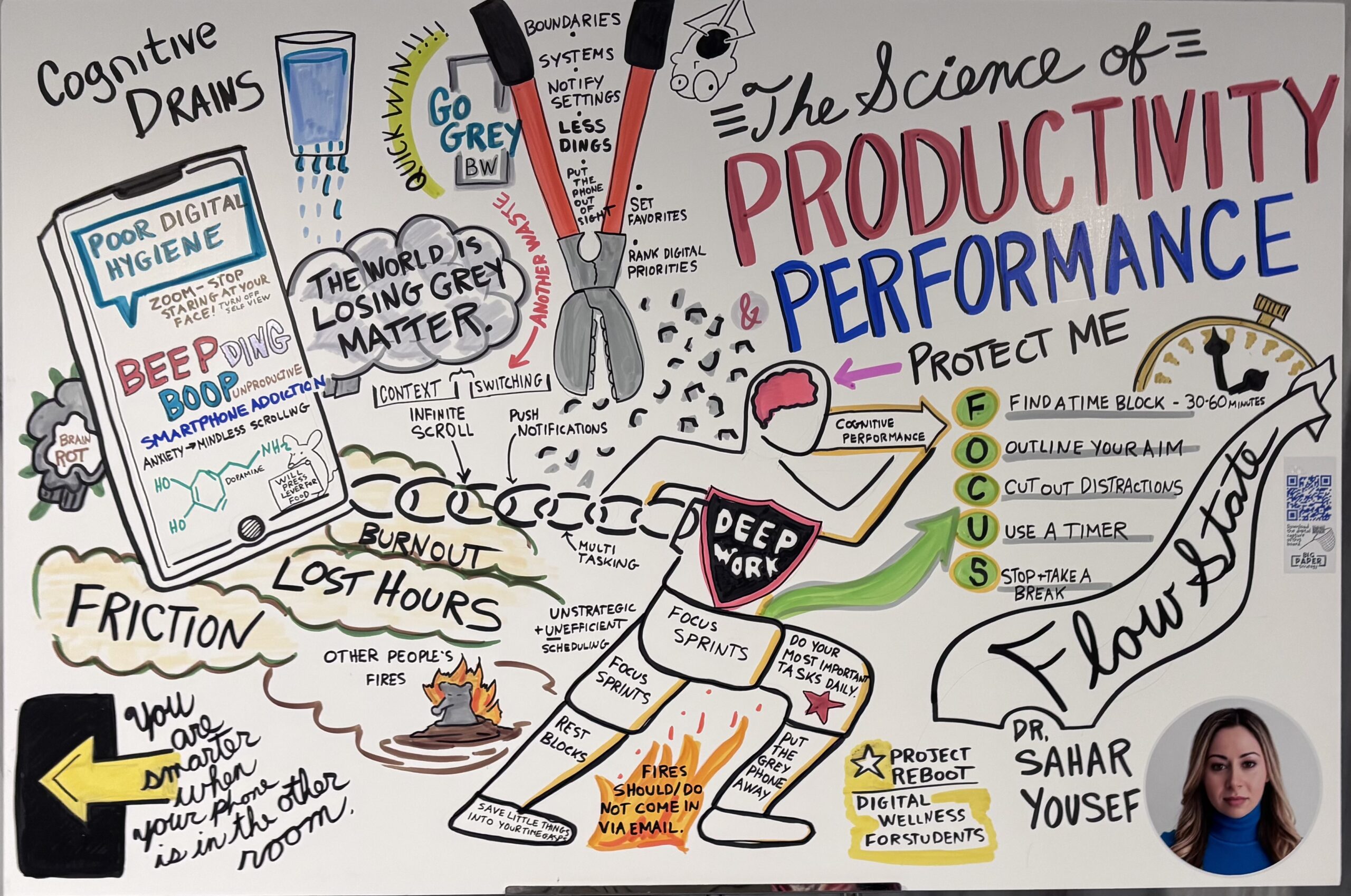
Sahar Yousef – The Science of Productivity and Performance
Oh, this talk was devastating. We already know our smartphones are stealing our productivity. Yet that fact has never hit as hard as it did when Dr. Yousef covered it. She focused on four mistakes we make and some thoughts on how to improve them:
-
- Poor Digital Hygiene – We are trained to scan the environment, and 35-40% of our brain real estate is dedicated to seeing or hearing to detect threats. On video calls, we spend 20% of our cognitive energy processing our own reflection (self view). The number one reason our cell phones are so addictive is our notifications, and we let FAR too many people have the power to interrupt us (news channels, random spammers, etc.). Dr. Yousef cited some fascinating research showing that having our phones in view makes us dumber. Here’s the kicker: The phones in the research were turned OFF. Not silenced, not on Do Not Disturb, OFF. People performed worse on cognitive tests when a smartphone was visible, even when they knew it wouldn’t interrupt them. Yikes.
- Bad Priority Scheduling – We tend to seek the quickest and easiest dopamine hits, which is when we get a little satisfied rush from completing a task. That means we are more likely to complete small, even unimportant tasks before we will tackle the big ones. Then we never get to the big tasks and they roll over from to-do list to to-do list, never getting completed (oh, I am so guilty of this one). Dr. Yousef compared our to-do lists to a refrigerator. We tend to look at the whole thing and would rather pick an easy snack than pull out all the ingredients we need to make dinner (was the chicken even thawed?). Only when we must do we pull out a bunch of raw ingredients to make a meal.
- Excessive Multitasking – We truly can’t do two things at once. We can divide our attention, we can (try to) bounce between topics, and we can constantly respond to email as it comes in. Yet multiple studies have shown we lose about 20% of our productivity to context switching, which Dr. Yousef noted is 2+ hours daily. She also noted that even dealing with email every 30 minutes causes people to get more done with less stress than if they constantly have their inbox open to deal with emails as they come in.
- Unstrategic Scheduling – Most people are bi-phasic, which means we have peak productive times at 9 am and 8 pm. While many think they are AM-shifted, that’s only about 20-25% of the population. We do live in an AM-shifted world, so the 15-20% of the population who are PM-shifted tend to struggle. Dr. Yousef noted this subset of the population evolved to take the night watch and keep us all safe back when we lived in caves.
So what do we do about all of these mistakes? How do we improve our productivity using this info? Luckily, Sahar Yousef has thoughts. I’ll share her concrete actions below, these are in order for the mistakes above but not a one-to-one ratio.
-
- Create VIP notifications; and be a bit ruthless. Ask yourself: Who is important enough in my life that they’re allowed to interrupt my thoughts? Apply this to email, messages, and every other beep, ding, or boop you could experience. Everything else should be when you’re ready to check them and not on their timeline.
- Turn your self view off on video calls. You’ll feel less drained at the end of the day, and you’ll do a better job of paying attention to the people on the call. Keep your camera on, but get rid of the little mirror. Your hair looks great, I promise.
- Put your phone on grayscale using the accessibility settings. Our smartphones are engineered with appealing colors that make us want to look at them. If you set your phone to display grayscale, it can save you 20-60 minutes per day in screen time. Photos still take in color, but they just don’t show that way to you. Grayscale reduces your dopamine hit from all the pretty colors on your screen. I have done this and committed to trying it for at least a week. After a few days, I found the normal colors seem kind of garish looking and I was surprised how much they seemed that way. We’ll see if it has a long term impact on my screen time, let me know if you grayscale your own phone!
- Get your phone out of sight. Even in Do Not Disturb mode, our phones make us dumber. So put it in a bag or pocket, or even just behind you while working. This one still blows my mind a little.
- Set 1-3 major tasks to accomplish in a day every morning (Dr. Yousef called these MITs for Most Important Tasks). When setting these tasks, ask yourself what 8 pm you will consider a successful day (this made me think of my Thank Your Past Self article!). Dr. Yousef suggested writing them down on a post-it note every morning and not allowing them to roll over and over, day after day.
- Create 60-minute blocks of focus time and plan them out. Make an outline of what you want to accomplish with your hour and how long each task is likely to take you. Protect these focus times and make them public to your team. Don’t schedule over them. I confess I tried hard to do this while in corporate life and often failed. My focus times got scheduled over or ended up with me trying to tackle emails for two hours. I’ve never been good at scheduling focus times and sticking to them.
- Make a parking lot for errant thoughts while focusing. Especially when we’re not used to giving our brains focus time, the minute we aren’t doing other things our brain starts to “shout” things at us. “Make that dentist appointment! Don’t forget to follow up with Rob! You said you’d invite Lisa to tea ‘soon’ three weeks ago!” It also tends to happen right before bed. If that’s happening to you, do a brain dump either right before bed or at the beginning of focus time, whenever it’s happening most. Put the errant thoughts on a list and then revisit that list when your focus time is over.
- Take a brain break at the end of focus time. Go for a walk, go to the bathroom, etc. once you’re done with your focus time. It’s a little bit like a reward, but also a reset. Don’t just go straight to your inbox and start working through emails, take a spin around the office first.
- Schedule based on your chronotype. If you’re bi-phasic, schedule your big, important work at 9 am or 8 pm. If you’re AM-shifted, don’t try to get big things done after noon.
I loved how actionable Dr. Yousef’s talk was, in addition to being engaging. I’ve been thinking for some time I need to work on my smartphone hygiene, perhaps this will help me get there.
If you’d like to talk about conferences (supply chain or otherwise) or anything else, let’s chat. If you’d like to get these articles weekly straight to your inbox and never miss one, sign up for my newsletter.
My book, Transform Procurement: The Value of E-auctions is available in ebook, paperback and even hardcover format: https://www.amazon.com/dp/B0F79T6F25
My chapter in the powerful anthology Femme Led: Hard-Learned Lessons from Women in Leadership is now available in ebook and paperback format: https://a.co/d/0bOzma8F