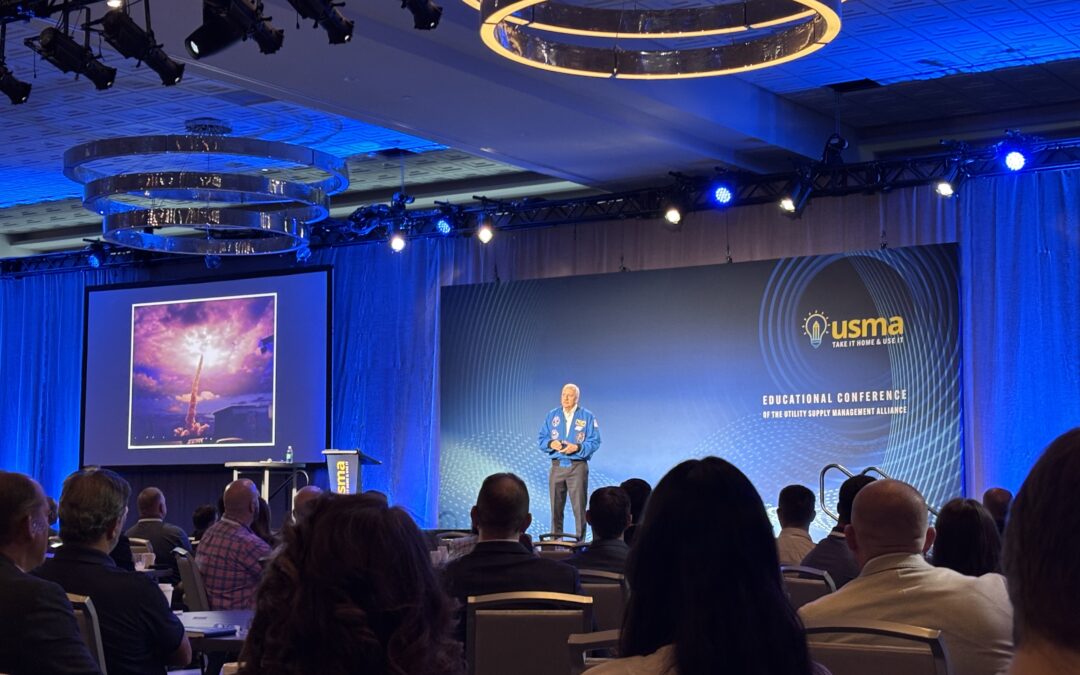
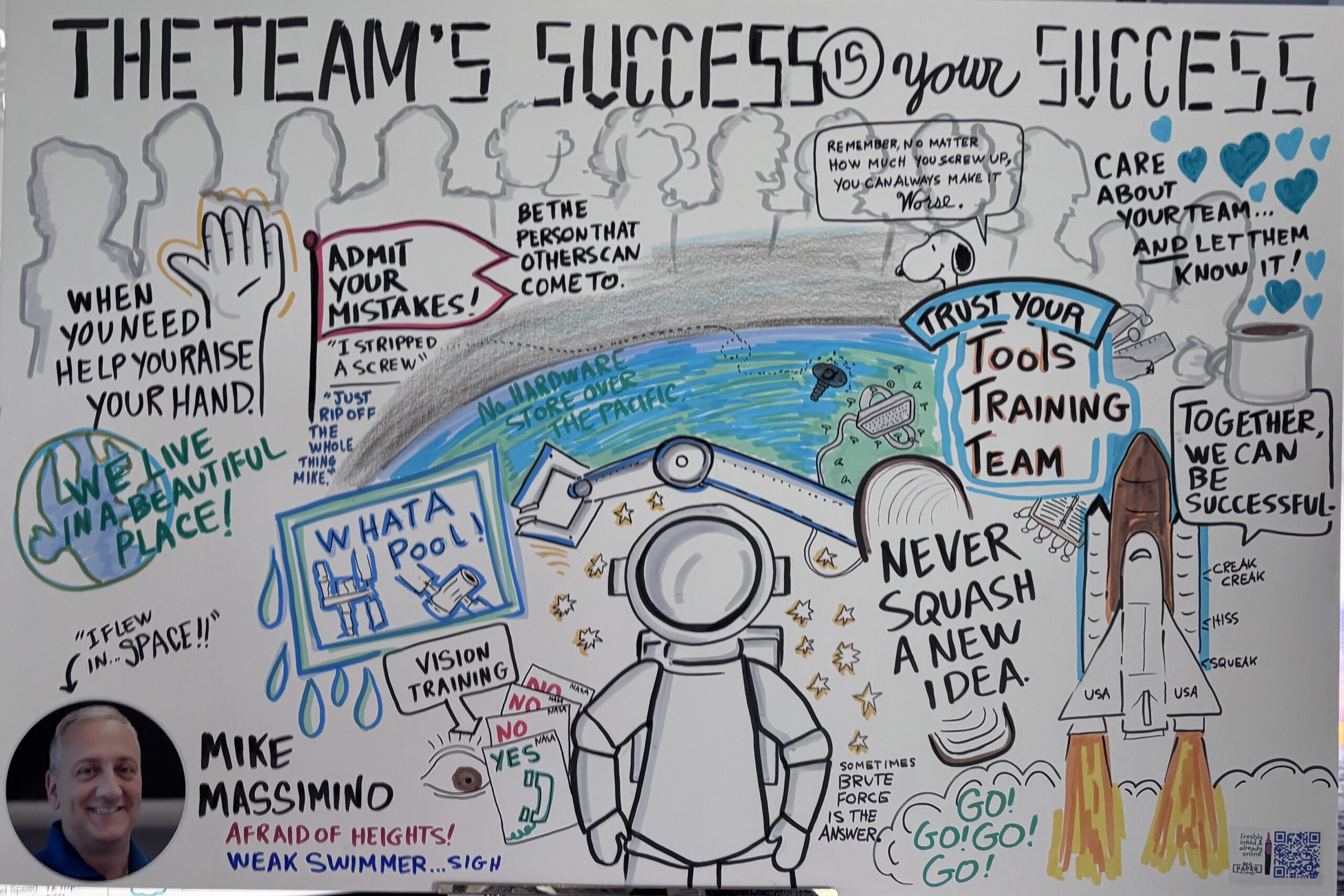
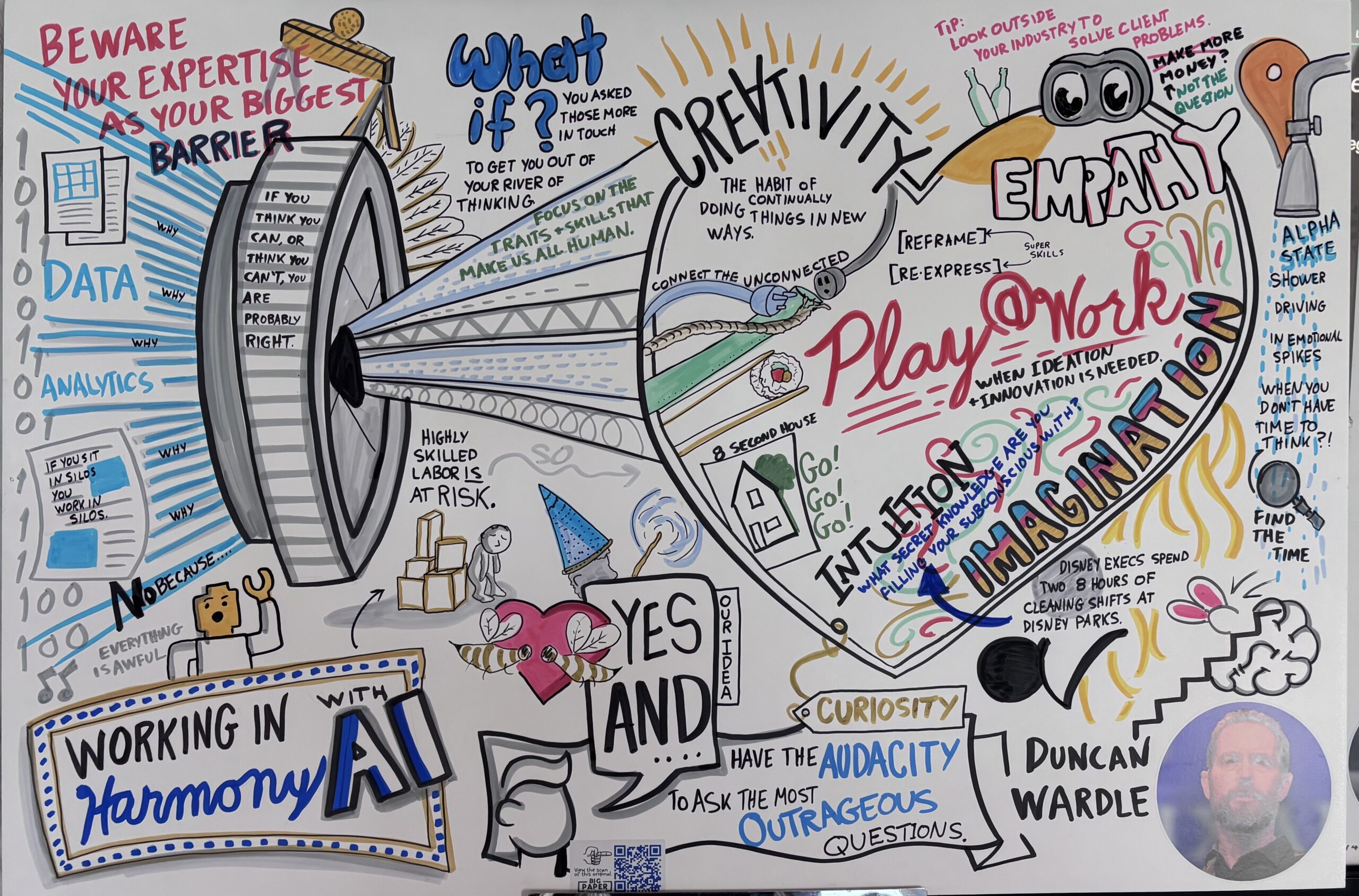
For a utility conference, the keynotes were shockingly (refreshingly?) non-utility. I just got back from the Utility Supply Management Alliance (USMA) conference in Florida, and what an interesting conference! I got done typing my notes from the four (!) keynotes at the conference… and discovered this article was way too long. So today we will cover the notes from Mike Massimino, NASA Astronaut and Duncan Wardle, former head of Disney Innovation. Next week we will cover Chris Thornberg from Beacon Economics on the state of the US economy and Sahar Yousef, neuroscientist on productivity (her talk was profound and devastating). Any one of these people would have been a phenomenal keynote on their own for any conference, and the combination of all four makes a solid impact. This conference also had a really interesting twist: they had a live illustrator for each talk, building a graphic summary as the talk went on. Matt Orley of Big Paper Strategy really synthesized ideas, created amazing graphics, and created something beautiful for each talk. Let’s work through my notes and thoughts for each keynote, hopefully you can take something away as I did.
Mike Massimino – Former NASA Astronaut
Mr. Massimino is a bit of a celebrity in his own right, with appearances on TV shows like the Big Bang Theory in addition to being the first person to Tweet from space. His overarching message was: The team’s success is your success, and that mantra shows up in everything he did as an astronaut. Mike was rejected as an astronaut three times before being accepted, and his advice to an audience member asking about the astronaut path for her son was that her son should instead follow what he’s interested in. Mike had fellow astronauts who were veterinarians, oceanographers, and the “traditional” aerospace engineers. As long as it’s in a STEM field, his philosophy was very much: follow what you’re interested in and enjoy doing, and if being an astronaut comes, it comes.
Beyond that response to a question from the audience, Mike’s message was about teamwork. Every US spaceship that goes up from NASA has at least one Russian on board, and every Russian spaceship has at least one American on board. He told the story of a swim test early on after becoming an astronaut. The instructor asked the strong swimmers in the class to raise their hands. Then he asked the weak swimmers to raise their hands (Mike was a weak swimmer). He sent everyone else home and tasked the strong and weak swimmers with working together over the weekend until everyone could pass the swim test. Mike’s message here was: Ask for help. Not asking for help hurts the mission. When I was the leader of a team in the corporate world, it’s true I’d much rather have someone on my team ask for help than quietly let something go badly. Mistakes were fixable once I knew about them. Problems were solvable once we brought more resources in. We have to put aside our egos long enough to support the mission instead of our own ambitions, even when that’s hard.
An additional part of the team mentality was never squashing someone’s idea. This is not groundbreaking or new, but Mr. Massimino’s angle on it was that when you squash someone’s idea, they don’t come back again for a while. While we all intuitively know this, it’s a good reminder when you’re working with a team. You’re not just dismissing that one idea, you’re losing their next several ideas. After all, in order to have good ideas, one must have many ideas.
The last point Mike Massimino made I want to highlight was what he called the three trusts: trust your tools, trust your training, trust your team. He said he was nervous on missions, and that’s natural and OK, but often the anticipation was much worse than once he was in it. He had the tools, training, and team to succeed, and he knew they wouldn’t send him into a mission without the necessary success factors. I have a corollary to this from my own experience: build the tools, training, and team worth trusting. I’ve been burned before by trusting my team to get something done when they didn’t have the resources they needed to accomplish it (and maybe didn’t ask for help). It’s all well and good to trust NASA, but sometimes in other organizations it’s our job as leaders to build structures worth trusting so our team can succeed.
Duncan Wardle – Former Head of Disney Innovation
Next (right after Mike Massimino!), we heard from Duncan Wardle, speaking about creativity and innovation. As an author and sometimes speaker myself, this man was in a class of his own on keynote speaking. I would characterize his overall message as: In a world of AI, it is our creativity, curiosity, and innovation that becomes our most important skill. He asked the audience what stands in the way of our creativity? Answers: Time to think, resources (i.e. budget), being measured based on results instead of effort, idea killers (remember, we were right on the back of Mr. Massimino’s talk), and having different definitions of creativity. He redefined creativity as: The habit of continually doing things in new ways to make a positive difference in our working lives. With that as the definition, many of the objections fall away, because it’s just about doing the things we do in new ways.
Next Mr. Wardle talked about curiosity and the fact that Western education teaches us to stop asking “why” because there’s only one right answer. He asked why business gets done on a golf course? Because physical activity fuels curiosity and creativity. If you’re trying to get a deal done, take a walk together. We ran through two exercises to demonstrate the importance of language in fostering creativity and curiosity. In both cases, we were paired up and were coming up with ideas for a birthday party with a $100,000 budget. In the first exercise, as one person came up with ideas, the other person had to start their response with “No, because…” As ideas were generated, they tended to get smaller and smaller in response to all the “no’s,” even though the budget was the same. In the second exercise, every response had to start with “Yes, and…” That key phrase “Yes, and” led to bigger and more creative ideas, to the point where sometimes it got hard to come up with new creative responses to respond “Yes, and” with. Duncan’s point was that it’s easier to value engineer a large idea down than to expand a small idea.
Next Mr. Wardle talked about how to work on a challenge. If you’re working on a challenge, start by listing the rules you’re assuming or working under. Then start asking: What if? What if you’re in a different environment? What if that rule didn’t exist? What if we could solve the customer’s biggest pain point? Then he asked: Who else? Who should be in the room to give a different perspective? If it’s a room full of executives, who is on the front lines of the company who can offer a new thought? His example was someone in Disney’s call center knowing what would actually increase ticket sales. Between “what if?” and “who else?” you’re on your way to a creative solution. He ended his talk by saying we need to be brave to be creative, and the opposite of bravery is not cowardice, it’s conformity.
Going back through my notes, he was an engaging and uplifting speaker. While he was speaking, I was paying good attention and took decent notes, but I’m finding now there’s less of a cohesive message than I would have liked. I also don’t think Mr. Wardle has fully adjusted his talk to the AI world, even though it was pitched that way. I would have liked to have him hammer home the importance of creativity in an AI world a little harder, with more concrete thoughts on using AI to boost instead of kill creativity. My notes are a bit scattered, and I think his talk was a bit scattered as well. He’s definitely not the type of person with a rigid outline, but it felt a bit like he was trying to cram too many things into too small a timeframe.
Come back next week for coverage of a session on the state of the US Economy (it’s not what you think) and some notes on productivity full of actions that can change your life.
If you’d like to talk about conferences (supply chain or otherwise) or anything else, let’s chat. If you’d like to get these articles weekly straight to your inbox and never miss one, sign up for my newsletter.
My book, Transform Procurement: The Value of E-auctions is available in ebook, paperback and even hardcover format: https://www.amazon.com/dp/B0F79T6F25
My chapter in the powerful anthology Femme Led: Hard-Learned Lessons from Women in Leadership is now available in ebook and paperback format: https://a.co/d/0bOzma8F