
Most procurement teams don’t have a category strategy problem, they have a category taxonomy problem. If your categories are unclear, inconsistent, or overly broad, everything built on top of them starts to break down. And yet, category taxonomy is something that lives in the background, without thought or further examination. When I start working with a new business to elevate their supply chain, I often ask about their category taxonomy. Depending on their supply chain maturity, I’ve seen everything from “We have no categories at all” to “Our categories are aligned to UNSPSC with some additional granularity in our key areas.” While categories are not the most exciting topic, they are a fundamental procurement tool and having a good category taxonomy is a critical part of running an efficient supply chain. Today let’s talk about category taxonomies: why they’re important, options, pros, cons, and things to think about.
Why Categories Matter
I’ve talked previously about the importance of category strategies in managing spend and capturing procurement value. While this seems obvious, before we even start to think about our category strategies we have to have categories. Categories serve the following purposes in an organization:
- Allow for division of work. This is the most obvious use of categories: to help the procurement team know who is responsible for what work. Often I see businesses that grew too fast or have a very small procurement team who lack categories because there is no division of labor – one buyer/procurement manager means one set of categories! I would argue even a very small procurement team can make good use of clear categories. “Begin with the End in Mind,” says Steven Covey, chances are good the procurement team will grow.
- Help accounting with taxes. I think procurement professionals often forget they aren’t alone in needing or using categories. I’ve seen many organizations where the accounting team and procurement team each use different category taxonomies, each unaware the other team even has category codes. Different categories (i.e. travel, contractor services, freight, etc.) have different tax implications in different jurisdictions, so it’s important to be able to categorize spend according to those categories. I view it as a bonus if the accounting and procurement/operations categories align.
- Determine bid cadence, timing, and scope. Procurement never exists in a bubble, we are extremely interconnected to world events and commerce. Having categories that align with global commodities (oil prices, anyone?) can help determine when categories should be bid. The scope of a category can also help you determine what you’re bidding or managing with suppliers (is the category all steel of any shape, or are you going to give sheet steel its own category? How about thicker plate steel?). Perhaps your sheet steel and plate steel suppliers are different, or the markets and shipping requirements are completely different, so they need different categories to manage properly.
- Improve system interconnection. Interconnection is another part of categorization that often gets missed. When integrating a demand planning tool, procure-to-pay tool, and ERP system, it can be extremely helpful to check data and ensure those connections are clean if you have a category taxonomy. Otherwise all you have is big data lakes with pathways between and chaos in the middle. It’s also possible you don’t actually want to integrate all of your spend, so categories allow you to be picky. Perhaps there’s no reason to integrate your indirect spend with your production planning tool, but with no categorization you’ll have to be dealing with all your data every time you integrate new software.
- Enables data analysis. If you’re using a Kraljic matrix or similar tool to determine your strategy, you need some way to subdivide your data. While you can subdivide by supplier, that means you’re at the mercy of which suppliers can provide what products. It also might mean you miss an opportunity for better value by splitting categories across multiple suppliers.
It is worth noting that implementing a major system, such as an ERP system, tends to trigger a look at categorization and force a business to adopt a category taxonomy. It can be a lot of work to categorize data and keep it categorized, so often that work is part of a larger improvement or digitization effort.
Category Taxonomies
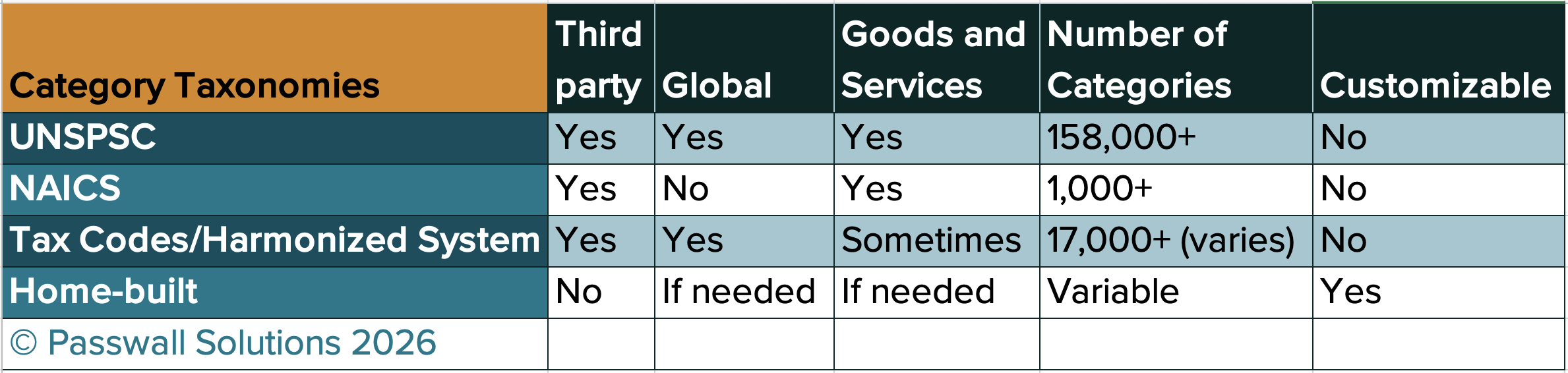
Let’s go through some of the most common category taxonomy options, pros and cons of each, and things to think about if these are your choice (or if they’re what you’re currently stuck with).
UNSPSC
The United Nations Standard Products and Services Code (UNSPSC) is my personal favorite category taxonomy. Yes, that UN. This taxonomy is newer than I thought it was when I looked it up for this article, and was created as a joint venture between Dun & Bradstreet and the United Nations in 1998. It uses 8-digit numbers where each pair of numbers adds granularity to the category. For example, the code 10101501 indicates Segment 10 (Live plant and animal material and accessories and supplies), Family 10 (live animals), Class 15 (Livestock), and Commodity 01 (Cats). I’ve also seen a variation where companies will only use the first six digits of UNSPSC in order to keep their categories less granular.
Pros: The biggest pro of UNSPSC is that it’s managed completely by a third party. As the world changes, adds new products and products become obsolete, the internal business team doesn’t have to keep up with those edits.
The UNSPSC categories are also global and well-recognized, even in non-UN countries. They are a nearly universal language for which categories a supplier can provide. Because UNSPSC categories are numeric, they can even be used to communicate when languages are different between buyer and supplier.
UNSPSC is natively programmed into many procure-to-pay software systems, such as Synertrade or Ariba. The taxonomy is common and universal enough that when you purchase these softwares, UNSPSC is already loaded in.
Someone can tell at a glance what kind of commodity something is if they know their basic UNSPSC segments. For example, if the number starts with 64 or greater, the commodity is a service instead of a good. It only takes a little bit of memorization to be familiar with the segments, as only 58 segments are currently active (and likely many of them do not apply to any given business).
Cons: There are a LOT of UNSPSC categories. The August 2023 list had 158,448 different codes. So understanding the segments, families, classes and commodities can take some time and many businesses don’t want to go through that effort. There also might be multiple categories that “fit” a given good or service, so it’s easy to inadvertently introduce noise into the data. For example, my business could be 80101704 – Supply chain analysis or re engineering service, 80101706 – Professional procurement services, 81141600 – Supply chain management (under manufacturing technologies), or 86101704 – Procurement or supply chain training. None of those fit precisely, although 80101706 for procurement services is probably the closest.
No business is going to use all of the codes, so some decisions must be made about which to exclude. This can take a lot of work and may result in disagreements. When I was implementing UNSPSC, I required that every top-level segment be included in our categories, whether we also included their families, classes, or commodities as well. While you wouldn’t think a utility would ever use live animals, we did actually rent goats and sheep to “mow” under our solar farms.
The UNSPSC list can also be extremely detailed and granular at times, and oddly broad at other times. For example for utilities, code 39121001 is Distribution power transformers, but there is no code for larger power transformers (you can go up a level to 39121000 for Power conditioning equipment). Especially for small businesses or extremely niche markets, there might not be a UNSPSC that correlates to your biggest or most strategic category.
Things to think about: Realize it’s likely you will need to modify UNSPSC before it works well for your business. Consider carefully how you will decide what to include, at what level of detail, and who gets to make that decision. Is it your transformation project leader? Your supply chain/procurement leader? A committee that votes? You might need to “add” categories for your specific business, either using letters to show they’ve been modified or by adding digits to the existing UNSPSC categories.
NAICS
The North American Industry Classification System (NAICS) is another third-party-managed list. This list, as the name implies, is North American, and is used more to classify businesses than commodities. NAICS codes are 5-6 digits and are similar to UNSPSC where each digit or pair of digits adds granular information to the previous set. The first two digits are the business sector, the third digit is the subsector, the fourth digit is the industry group, the fifth digit represents the NAICS industries, and the sixth represents national industries. I first encountered NAICS in my MBA program, and it is a common system to teach in US business schools.
Pros: As with UNSPSC, it’s nice to have a third party managing the codes. There is very little category maintenance to do within NAICS.
There are only about 24-26 active segments, so there are fewer than half as many as UNSPSC to manage. Similarly, there are only about 1000 total NAICS codes.
Suppliers in North America have a NAICS code, and those codes are also assigned to individual facilities instead of the company as a whole. This can make NAICS codes very handy to find individual suppliers and even sometimes determine which manufacturing facility makes the individual product you want to purchase.
Cons: The largest drawback of NAICS is that it’s very North America-centric. If your company does a lot of business outside of North America, it’s likely you will need to translate to a different system or simply communicate your category codes to suppliers and potential suppliers. Especially suppliers who do limited business with North American companies will tend to struggle to understand or translate to NAICS.
Things to think about: As with UNSPSC, any company will also need to make decisions about which NAICS codes suit their business. The goal is to be granular enough to categorize spend without getting so granular that you are drowning in categories. It’s also important to understand how geographically bound your business is and how bound it is likely to be in the future.
Tax Codes/Harmonized System/Harmonized Tariff System
There are few variations on using tax codes, but I’m going to focus on the Harmonized System (HS) or Harmonized Tariff System (HTS). This system is increasingly important in the supply chain world as it determines how trade taxes are charged when goods are sold between companies in different countries (or imported for sales to consumers).
Pros: As with UNSPSC and NAICS, HTS codes are managed by a third party (in this case the World Customs Organization). That means you don’t have to maintain them if you use them for internal categorization.
With tariffs an increasing concern, it is helpful to have purchases already classified by HTS if a business is importing a high percentage of materials. Even if most suppliers are in the same country as manufacturing, using HTS makes it easier to calculate total cost of ownership and if something should be purchased from another country and imported or purchased domestically for a higher price.
Cons: HTS codes are not perfectly consistent from country to country. The US uses a 10-digit code, but only the first 6 digits are international. There is also a slightly different list for exports from imports, because the importing company is the one that pays the tariffs. HTS codes can rapidly become confusing and tangled in government bureaucracy.
Tariffs change all the time, especially in the US over the last couple of years, so companies might want to constantly be evaluating how they classify expenditures. It would be very easy to have the internal categorization not match the tax codes used for import/export, causing confusion. One of the tariff mitigation strategies is to carefully consider options for HTS classification, adding another layer of potential changes and mismatches to using HTS for categorization.
Things to think about: As mentioned earlier, HTS codes tend to be highly bureaucratic and more changeable than other taxonomies. It is an uncommon system to use for internal categorization, but if you are a business that does a lot of importing and exporting it may be of use to you.
Home-Built
The last major categorization strategy is simply to come up with your own. I’ve seen many businesses have categories according to their own systems and classifications, without any third party input. Sometimes I’ve seen these categories actually reflect a key supplier or key customer’s taxonomy instead of being built within the business.
Pros: A home-built category system is entirely customizable and can reflect as many or few categories or subcategories as desired. If the system makes sense to your team, then that is enough. You ultimately have a lot of control over what is or is not included, how granular to get, and even the use of alphabets instead of simply using numbers.
Typically home-built category systems grow into place over time, so this is the most likely “incumbent” system. It is a pro not to have to rip and replace or redo categorization completely. The category system might already be part of your culture, whether you realize it or not.
Cons: A home-built system must be maintained. What if you branch into a new product line? Does it get some new categories? Part of maintenance is manually entering it into any ERP system or other category-driven technology.
Home-built systems can also be harder for new employees to learn. They may have used UNSPSC or NAICS at a previous employer, but a home-built system guarantees they have to learn a new system. This happens again with new suppliers, although it is less critical that suppliers learn your categories. It does mean it might be harder to find new suppliers for a category as you will have to translate to NAICS or UNSPSC to do some supplier searches.
Things to think about: Consider studying a few of the third-party taxonomies before building your own in-house. They have some best practices worth exploring, such as the number digits coming in pairs and increasing in granularity as they go. You might also be able to start with the top-level categorization from UNSPSC or NAICS and then customize from there.
While not the most exciting topic, category taxonomies are important. If you’re working through a larger transformation and haven’t thought about your categorization, consider pausing to do so. If you would like to talk about your category challenges or any other procurement/supply chain topic, let’s chat. If you’d like to get these articles weekly straight to your inbox and never miss one, sign up for my newsletter.
My book, Transform Procurement: The Value of E-auctions is now available in ebook, paperback and even hardcover format: https://www.amazon.com/dp/B0F79T6F25
My chapter in the powerful anthology Femme Led: Hard-Learned Lessons from Women in Leadership is now available in ebook and paperback format: https://a.co/d/0bOzma8F