Supply chains are complicated. Those of us who do procurement or logistics are constantly arguing that our job is not just “shopping” or “booking trucks,” just as warehousing is not just “stacking pallets.” Every step of what we do has a process, written or unwritten, and those processes affect everyone in our business. When there are too many processes, many of them are a bit broken (and therefore have changed from process into problem), and all could be getting your business more value, where should you start? Trying to improve everything at once is a great way to improve nothing. Yet making no attempt at improvement is no good either.
Often we fix the loudest process or the process the person with the most organizational power cares about. In our data-driven, AI-enabled world, the loudest or most annoying problem may not be the highest-value problem to fix. Today’s article talks about concrete criteria to evaluate processes, the standard matrix to organize priorities, and some examples using last week’s article on real world opportunities.
Impact Framework
If the loudest, most political, or most convenient problems are not the right place to start, what should we use to prioritize process improvement? There are never enough resources to solve them all at once. Let’s start with the impacts from solving problems/process improvements we can measure and some examples of where we find them:
- Financial impact – this is where everyone starts, and also often the only criteria anyone wants to use. In procurement, this is the process improvement which generates the most savings. Evaluating process opportunities based on financial impact is probably the easiest of the criteria, at least for us procurement professionals.
Examples: the highest financial impact probably comes from creating written contracts (usually 1-3% savings), which solves the problem of constant, random supplier price changes with no guidelines or limits. The other main financial impact comes from structuring clean category strategies (usually 2-10% savings), which solves the problem of three different departments buying the same thing from different suppliers (or even the same supplier!) for different prices.
- Risk – in an organization with an engaged CEO, risk is the next supply chain criteria to consider. Really it’s next in any organization, but many procurement teams have to fight hard for the rest of the organization to consider risk.
Examples: the biggest risk reduction opportunities are usually in establishing a forecast (which lowers risk for both buyers and suppliers) and establishing contracts to at least codify risk in written terms. Forecasting helps solve the problem of constantly increasing supplier lead times, often even after POs are placed. Contracts resolve frequent supplier disputes, like when the acknowledged PO payment terms don’t match the supplier invoice.
- Frequency/volume – these are the “noisy” problems you’re battling every day and year after year. Or these might be the executive pet project and therefore there is a loud, powerful voice asking for them.
Examples: the most frequent supply chain process issues are cutting purchase orders and receiving shipments. Usually held by two separate teams, POs and receiving are something everyone sees every day and tend to annoy executives when they’re slow or messy. Frequent/high volume problems look like purchase requests/requisitions sitting in buyer queues for days or weeks before turning into a PO, messy warehouses that are hard to walk through, and system inventories that are constantly inaccurate.
- Business criticality/alignment – for supply chain problems, these go back to our favorite iron triangle of cost, quality, and lead time. More importantly, this is where it’s important that a company knows what their priorities are (cost, quality, or lead time, and in what order?), and it should be based on what the customer values most. This parameter is about how well solving a problem aligns with what the company and customer prioritize.
Examples of business criticality/alignment and the problems they solve: When I was at Vermeer, in most markets we prioritized and competed on quality. While we needed to keep pricing in line with competitors, we often made decisions to choose a nicer, higher-quality component because that aligned with our priorities.
- Customer/employee impact – this parameter is all about people. Small changes might affect most of your workforce or make a big difference to customers. Measure this either on severity of impact (a few people are now put in harm’s way or have major changes to their work) or breadth of impact (although it’s a small process, LOTS of people are affected by it).
Examples of customer/employee impact: On the supply chain framework, this might show up most frequently with logistics. Changing your inbound or outbound logistics firm/process has a big impact on warehouse and customer experiences, and problems with logistics affect everyone. I also once had a bid result in a change to a tool used to install a piece of material in the field. As a result, the lineworkers started using their pocket knives to cut the sheathing off the line to install it, dramatically increasing the safety risk. We got them a new tool to cut the line that was faster and easier than the pocket knife because the safety risk made the problem very severe and problematic.
Effort Framework
If we’re working our way to a 2×2 matrix (and we are!), the other axis from impact is effort. We know how awesome our solutions are going to be, but there’s still the question of how hard it is to implement those solutions. Here are the components of our “effort” scale:
- Cost – just like with financial impact, this one tends to be the only thing that is considered when solving a problem. What does it cost us to solve it? While cost is important, it’s not alone in considering the effort needed to solve problems.
- Timeframe – how long will it take to solve this issue? I think about this one as I walk by that one loose screw in my house that I know will take less than 5 minutes to get a screwdriver and tighten but somehow I never seem to get to it.
- Existing resources – if the solution for a problem requires specialized skills, do you have those already in the company? How about existing software (or increasingly, AI tokens)? Do you simply have the labor available to solve the problem, or is everyone running around busy without actually performing? (Side note: there are never enough resources to just do the things we want to. I’m asking if they can be made available, not expecting them to be sitting around waiting for work.)
- Difficulty – this is simply how hard the problem is to solve. In practical terms, this means things like: how many departments are involved (and how many different executives do they report to)? How much bureaucracy stands in the way (and isn’t good bureaucracy)? What is the company culture around this problem and its solution, are you a “we’ve always done it this way” culture?
- Risk – just as risk lives on the impact axis, it also lives on the effort axis. What’s the risk to the business if you devote resources to solving this problem? If you focus on solving the problem, do business-critical items slip?
2×2 Matrix
We made it to our 2×2 matrix! (I love a good 2×2 matrix. My math brain finds it very satisfying.)
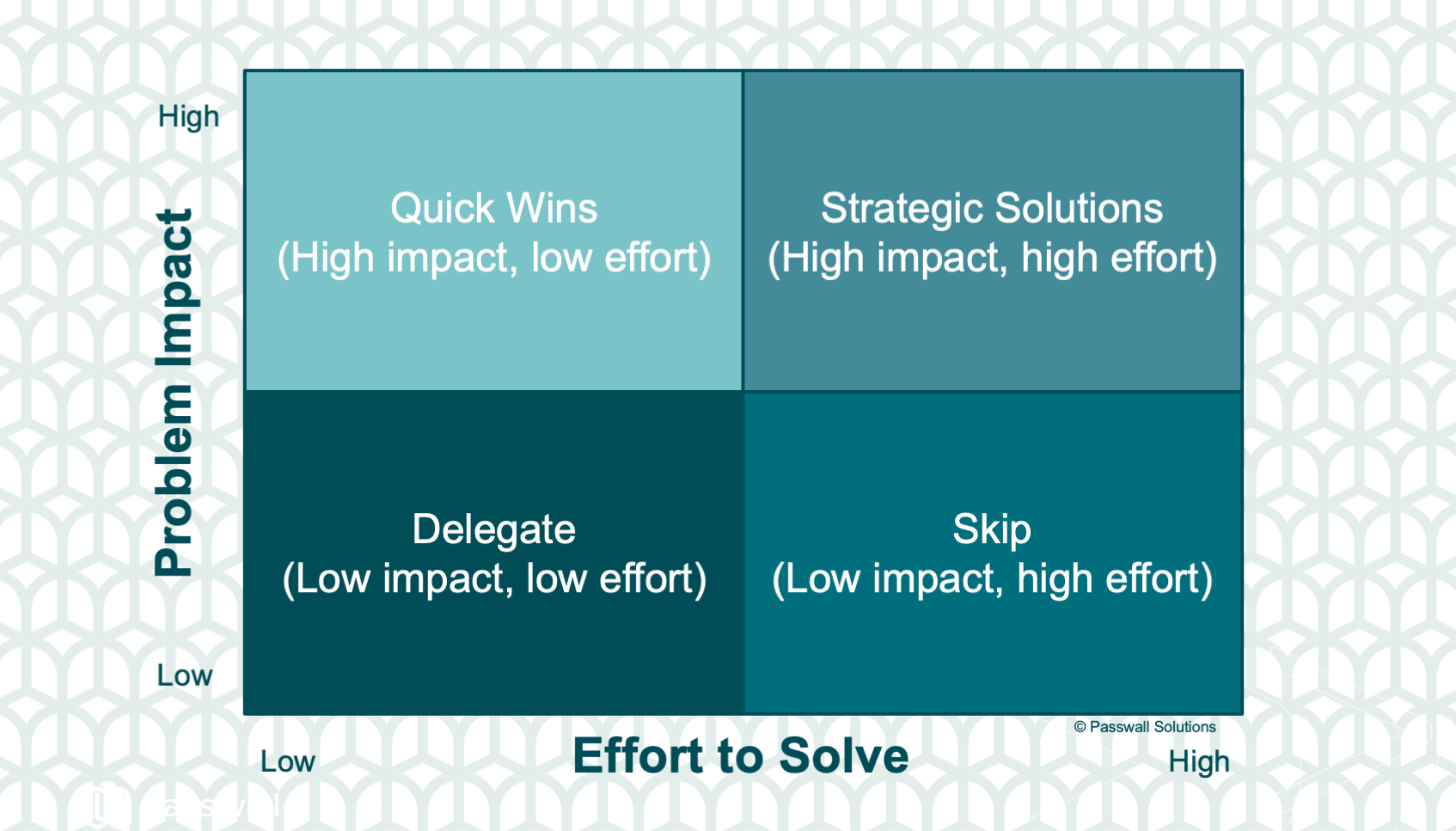
To put the problems to evaluate onto this matrix, consider assigning a 1-5 scale (where 1 is low and 5 is high) to each dimension of the problem: financial impact, risk, frequency/volume, business criticality/alignment, and customer/employee impact. Next, assign similar ratings to your effort parameters: cost, timeframe, existing resources, difficulty, and risk. Add up your scores for each and put the result on this chart on a total scale of 0 to 25 for each dimension.
Let’s do an example.
Let’s say the problem is that steel suppliers are coming to you with 20% price increases due to tariffs. Financial impact is high (5) because a 20% price increase is huge. Risk is fairly high because steel is central to our business and it’s currently all our suppliers coming to us (4). Frequency/volume is medium because right now it’s a “temporary” increase (3). Business criticality/alignment is low because we’re a company that emphasizes quality and lead time and our customers prioritize it as well (2). Customer/employee impact is medium because our customers do still care about price (3). So our total impact score is 17 out of a possible 25.
On the effort side, our cost is fairly high to solve this problem because we’re going to need to get category management processes going (we don’t have them yet) and probably also get legal involved to get some contracts in place (4). The timeframe for quick solutions is fairly short and this is supposedly temporary, but really we want a longer-term process and solution so our timeframe is high (4). Let’s assume we have a category management team in place, formed recently and given the software they need, so our existing resource effort is fairly low (2). Our difficulty is medium because even though this impacts many departments, the company has empowered the procurement team to solve it (3). Our risk is actually medium as well because this is within the core responsibility of the category management team, so the effort to solve this problem doesn’t involve major risk to the company by moving people off their core responsibilities (3). Our total effort score is 16 out of a possible 25. These two scores put us in the Strategic Solutions quadrant of our matrix, which is not surprising because this is the kind of problem that is a major disruption to our business. Done right, the solution will create a process and solve this issue for any future times a supplier proposes a major price increase.
Each quadrant is fairly self-explanatory, but let’s go through each:
- Delegate – I wanted to call this one “give it to the intern,” but that phrasing is easy to misinterpret. For the low-impact, low-effort problems, these are a great place for someone just starting out to help out the business, learn something, and add value. Often these are also the noisy issues or pet projects, so it can get a more junior person some visibility and a strong win.
- Quick wins – these are the low-effort, high-impact problems to solve. This is the loose cabinet knob in my kitchen that takes 2 minutes and screwdriver to solve. Just get them done and then celebrate the win. Quick wins are a way for the supply chain team to look good and add value, but don’t get addicted to them because most quick wins are really just firefighting dressed up as proactive problem-solving.
- Skip – it can be really hard to leave the high-effort, low-impact problems alone. They’re still problems, right? But they lead to busywork and burnout. They’re hard to solve, people aren’t usually very grateful you solved them, and they just hang out on to-do lists forever. If you have any problems like this, see if you can just decide you’re not going to solve them. If you can’t do so, they might actually belong in the strategic solutions category and you’ve underestimated their impact.
- Strategic solutions – these are the big ones, high-impact and high-effort. These should be the problems that, if you solve, they move the business forward. If you’re solving these problems in a way that doesn’t build a more proactive supply chain, you might need to relook at your processes and see how you can broaden these solutions to cover more situations. Otherwise, they’re simply not worth their effort (despite their impact).
Now you have some concrete tools for sorting your pile of problems, some examples of what those problems might look like (and how they fit with the supply chain cycle), and a more organized view of your priorities. Every organization is unique, so no one solution or prioritization suits every business. Process improvement isn’t about fixing all the processes. It’s about solving the right problems and fixing the right processes.
If you’d like to talk through your problem-solving and process improvement priorities, let’s chat. If you’d like to get these articles weekly straight to your inbox and never miss one, sign up for my newsletter.
My book, Transform Procurement: The Value of E-auctions is available in ebook, paperback and even hardcover format: https://www.amazon.com/dp/B0F79T6F25. My chapter in the powerful anthology Femme Led: Hard-Learned Lessons from Women in Leadership is now available in ebook and paperback format: https://a.co/d/0bOzma8F
This post was written entirely by me and not by AI. The article summaries, title, and graphic may all have used AI to assist/generate ideas/edit, but the article content is fully human.