After filling out first day paperwork and sitting through more cybersecurity training than anyone thought possible, the first thing a procurement professional is asked to do is run a bid. Also known as a “tender” in Europe, a bid is fundamental to procurement – solicit multiple options from suppliers to determine interest, price, and help refine the scope of work. Typically businesses call bids an RFx, or a Request For something. That something might be information, a quote, or a proposal. It can also be a request for clarification (RFC), request for tender (RFT, again this is more European terminology), request for qualification (RQQ to distinguish from RFQ), or request for solution (RFS); but the most common three are request for information (RFI), request for quote (RFQ), and request for proposal (RFP). Today’s article explores those three most common options in depth: what they entail, when to use them, and the likely result.
RFx Basics
While the terms “bid,” “tender,” and “RFx” are somewhat interchangeable, there are definitely nuances between them. The U.S. uses the terms “bid” and “RFP” to mean any time a procurement team is soliciting responses from suppliers to provide a good or service. Europe and a few other countries use the term “tender” similarly, but there are regulations in many European countries around tenders that emphasize fairness for both buyer and seller. For example, a utility in the UK must declare who won a tender and then not actually sign the contract for a full week to allow for time for suppliers to dispute the result. Having not worked in all industries, I do not know how widespread this approach is so will not claim further expertise on tender rules. Because I’m writing from the U.S., I will generally use the term “bid” and will speak to the professional and cultural nuances of the RFI, RFQ, and RFP from a U.S. perspective.
As mentioned in my article on award scenarios, it is extremely helpful to set the structure of a bid ahead of publishing it. Do you know how you will potentially award the work? Do you need an RFI ahead of the full bid? Do you only need a quick quote instead of a full proposal? While you may need to change the structure partway through due to unforeseen results, have a plan on which bid components you will need. This can also help put technical teams at ease with the bid process. If they know they have an RFI stage ahead of the full RFP, they know they have some space to evaluate suppliers and create a supplier shortlist while refining the scope. More on that in a moment, so let’s start with the RFI.
Request for Information (RFI)
The Request for Information, or RFI, is an often under-used procurement tool and is an investment of time at the beginning of the bid to save time and headache later. It is similar to a Request for Qualification (RQQ), but is more common and I think of an RFI as much broader than an RQQ.
What’s in an RFI?
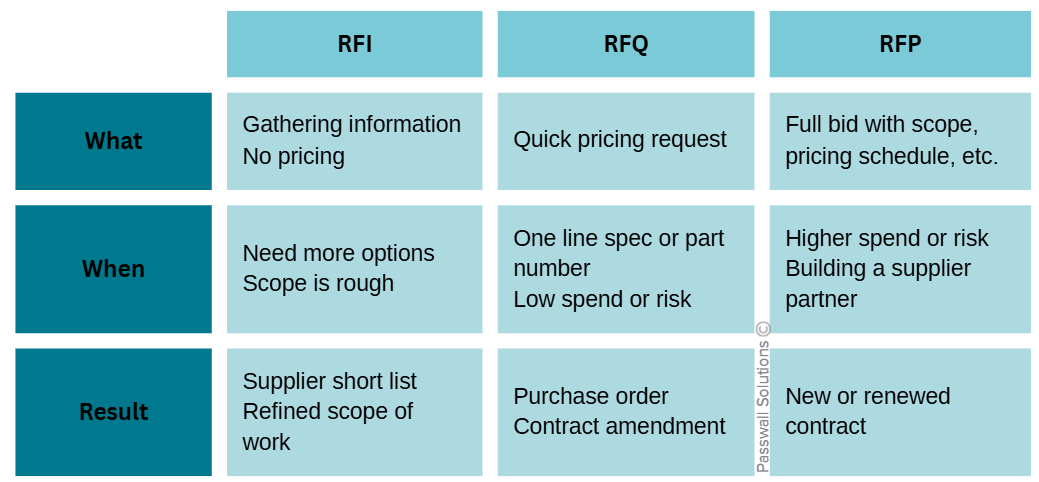
An RFI is for information only. As soon as you are gathering anything other than extremely broad pricing information (like budgetary pricing +/- 20%), you have an RFQ or RFP and not an RFI. I don’t consider something an RFI if it asks for any kind of pricing at all. An RFI is a chance to ask how pricing is structured in the supplier’s industry (monthly subscription? Per license/use? Annual fee?), supplier qualifications (years in business, certifications, enrollment in contractor safety record reports such as Veriforce, cybersecurity position), and maybe some questions about how the supplier would approach solving your problem or doing the work. An RFI is a chance to “play dumb” with suppliers without guilt or shame. In an RFI, you’re allowed to not know what you don’t know and use the RFI structure to try to find out as much as you can ahead of a more formal bid.
When to use an RFI
An RFI is great when you don’t know enough about the work to be done, the industry, or which suppliers would be interested in providing a solution for your business. They can be a way to expand a supplier list ahead of publishing an RFP or RFQ based on which suppliers have available capacity. I’ve even seen RFIs used to simply update confidentiality agreements, contact information, or capacity plans ahead of a more formal bid.
A recent RFP one of my clients ran involved inspecting an area for environmental impact and one supplier had an alternative option using dogs to do the inspection. A great option for them would have been to run a small RFI ahead of the RFP looking for all the approaches available. If you don’t know all the methods or alternatives available and want to really refine your scope of work, an RFI is a great option.
Note: Consider if you want to make an RFI response required for a supplier to be invited to the RFQ/RFP. An RFI takes a lot of work, so some suppliers (especially the incumbent) won’t necessarily put the effort into an RFI when they can focus their efforts on the RFP. If you’re going to require an RFI response to participate in the RFP, be very clear on this requirement and try to make the RFI response as light a lift for suppliers as you can.
Results of an RFI
The result of an RFI should be a short list of interested, qualified suppliers and a refined scope of work. You can even use the RFI to have suppliers redline the scope of work and then use those redlines to build a strong document. Be very careful if you do this not to write a scope where only one supplier can actually respond and meet the requirements. Expect suppliers to redline the scope to write in proprietary patents, special services, or other items only they can meet.
The short list of suppliers that comes from an RFI indicates which suppliers were willing to engage with you, invest time and effort in your RFI, and are interested in taking the first step to being a good supplier partner.
Note: if you run an RFI and then an e-auction, I would consider that a straight-to-e-auction and not an auction after RFP. That means following the guidelines of having contracts in place with all suppliers, having a very clear scope of work, and having multiple qualified suppliers competing. It is possible to run an RFI and then an e-auction, but I don’t see it done often. Typically there would be an RFQ or RFP between the RFI and the auction.
Request for Quote (RFQ)
Sometimes people use RFQ and RFP interchangeably, but I consider them to be very different. While they often get similar results, a request for quote, or RFQ, is much simpler and less effort for all parties than an RFP.
What’s in an RFQ?
An RFQ is just that: a simple request for a quote. It might not even have a full scope of work, instead just a manufacturer part number and expected annual volume or a one-line description of a service. It might have a drawing included (either created by the buying company or a link to an off-the-shelf drawing like those found on McMaster-Carr). An RFQ is often sent via email, even if the buyer has access to a source-to-pay platform or more formal bidding option. Sometimes it can be sent via the Enterprise Resource Planning program (ERP) enabling a quick conversion to a purchase order.
When to use an RFQ
An RFQ should be fast and simple. When the specification really can be summarized in one line or well-established part number, that’s a good time to use an RFQ. They should also be used for low-cost spend or low-risk purchases. There may be guidance in a procurement policy on when a business can issue an RFQ instead of a full RFP. I always think of an RFQ as the quick email that goes to three sales reps and says something like, “We’re building a new prototype with an estimated annual volume of 1,000 units per year. Can you quote me the price and standard lead time for manufacturer part number XXXXXX or something equivalent for both one piece and then an annual volume of 1000?”
I don’t advise an RFQ as a way to test the market in response to one supplier raising pricing for a couple reasons. First, I never like the only trigger to sending out a bid being in response to a supplier raising prices. It puts the buyer in a reactive position and that is never a position of strength. I far prefer planning bids by category or responding to dips in commodity indices. Second, RFQs should be fast. It’s hard for suppliers to come up with creative solutions to your “rising prices” problem if they’re just tossing a quote off with no opportunity for value-added options. And third, an RFQ should be for a handful of items only and not a long list. If a supplier is raising your price on one item they sell you, they are likely raising their prices on everything across the board. That probably means you should be reviewing the whole supplier relationship and all goods or services they provide.
Note: Send each rep an individual email for an RFQ because the BCC field is unreliable, reasonably easily hacked, and often lands your email in a spam folder.
Results of an RFQ
An RFQ typically results in a purchase order. This might be for an initial one or two items to test or install in a prototype, or it might be a blanket order for the next year. In some cases, it might result in an amendment to add the good or service quoted to the existing supplier contract.
Request for Proposal (RFP)
The request for proposal, or RFP, is the most common format for a full procurement bid. Typically when people talk about bids or tenders, they mean something that looks like an RFP.
What’s in an RFP?
An RFP is a fully formal bid event and contains everything a bid might need: go/no-go criteria, a full scope of work, a contract template, a list of qualified suppliers, potential acceptable alternatives or a call for those options from suppliers, an award timeline, logistics considerations, expectations for negotiation after the RFP, a full pricing schedule, any value-added options that might be desired, etc. A good RFP covers as many aspects of a purchase as possible.
When to use an RFP
Typically RFPs are used when procurement policy calls for a full bid (such as a spend threshold or a risk level). They also tend to take some time, with a minimum RFP allowing about two weeks for supplier response and then at least another two weeks for technical evaluation. All of that is after the scope of work and pricing schedule are complete, which I’ve seen take months to finalize. AI is very helpful with drafting scopes of work so the technical team doesn’t have to start with a blank sheet of paper, but it still takes time to review and refine a good bid package. RFPs are also typically used with a source-to-pay platform, and I recommend running an RFP ahead of an e-auction whenever practical. An e-auction is best used as a negotiation tool, not a bidding tool (see my article on e-auctions are a chainsaw).
Results of an RFP
An RFP probably results in a contract, even before it results in a purchase order. Contracts are an important part of procurement and are often neglected in smaller or less mature procurement organizations. While an RFP can result in a purchase order, and often does, I’m an advocate for putting in place full contracts with supplier partners. The level of effort required for an RFP from both buyer and seller should result in something stronger than a simple PO.
Here’s a quick table summary of these three common options!
The next time you’re asked to run a bid, consider your best course of action: RFI? RFQ? RFP? And then, how will you negotiate after the bid is complete? E-auction? In-person? If you’d like to talk about how to structure a complicated RFI or RFP you have coming up, let’s chat. If you’d like to get these articles weekly straight to your inbox and never miss one, sign up for my newsletter.
My book, Transform Procurement: The Value of E-auctions is now available in ebook, paperback and even hardcover format: https://www.amazon.com/dp/B0F79T6F25