
Since my book came out six months ago, I’ve been having even more conversations about e-auctions. I still wonder if instead of Transform Procurement I should have called my book E-auctions Aren’t Evil. And yet, procurement professionals tend to talk about their reservations against e-auctions in whispers. They’re being polite around me, as an author of a book about e-auctions. People agree with me that e-auctions have value, but then quietly tell their colleagues that e-auctions would work great… for someone else. After all, e-auctions are a chainsaw and not everyone is willing to climb the learning curve to operate a chainsaw with the skill needed to do so safely. Today let’s say the quiet things out loud; see if any of these sound familiar. I’ll talk about some of the objections I hear most, what they sound like, and my responses.
I Prefer to Negotiate With My Incumbent Supplier
“I have a good relationship with my incumbent supplier and there are only a few suppliers who can provide this, so I would rather just negotiate their price every year. Last year they came to me with a 10% price increase due to the tariffs and I got them negotiated down to a 5% increase!”
As procurement professionals, our job is relationships. This includes strong relationships with suppliers and our internal customers who run our business. And it’s true there are categories where only one supplier can do the work. However, it’s a trap I’ve seen multiple procurement team members fall into: prioritizing the supplier’s needs over their internal customer needs. Chances are good the internal customer didn’t get a 5% increase to their budget this year. Even if they did, chances are better they don’t want to simply toss that increase in budget allocation to the incumbent supplier. Then the sales team doesn’t want to pass a 5% increase on to your external customers. While a 5% cost avoidance is good, consider what truly serves your internal and external customers.
We do want our suppliers to be viable businesses on their own, because that means they continue to supply us. But they also have to compete in their own markets and stay competitive. Price increases over time are normal and part of modern economics, but I have trouble celebrating a 5% increase. If it’s been a while since you put your suppliers through a competitive bid process, consider doing so. That doesn’t mean you have to run an e-auction as your final phase, but it’s important to refine your scope of work, test the market, and seek value for customers. One huge caution: Don’t take your bid to auction if you’re not willing to award the auction winner the business. Awarding the second or third place auction participant without even trying to get a contract in place with the winner will undermine auctions as a tool for you forever. In every category. I’ve seen it happen multiple times and then the dialogue becomes “auctions don’t work.” They work and do what they’re supposed to, but you have to run them with viable business available (not just be seeing what the market is doing without having business to award) and you have to maintain the integrity of the process.
We Don’t Run Competitive Bids
“When we first quote an item, we bid it out to a few suppliers. Then we don’t really bid it again unless there’s a big price increase or the supplier has quality issues.”
I hear this one more frequently than I expect, and usually indicates a less mature supply chain (which is not a bad thing, it simply is part of the supply chain maturity process). Not running competitive bids truly is a barrier to e-auction because it is important to run a Request for Proposal (RFP) ahead of an e-auction most of the time. I’ve recently made the mistake of not sticking to my principles by running auctions without a reasonable RFP process ahead of the auction. While these auctions have been fine, they haven’t been as good as they can be as part of a full competitive bid cycle. That competitive bid is so important to vet suppliers for quality, ensure all suppliers are bidding on the same products/results, and ensure enough time to get supplier and buyer buy-in.
If you don’t currently run RFPs, tackle getting a competitive bid process in place first. That doesn’t mean you have to have Procure-to-Pay software, and you can definitely run an RFP through email and then still use a quick auction as your negotiation method. But do start with building a competitive environment within your supply base. Side note: I’ve recently gained the ability to run auctions for clients, so if you’d like help running a quick auction and want someone to do it for you/walk you through it without the commitment of buying software, let’s chat.
We Run E-auctions, But Call Them Something Else
“We run e-auctions, but call them interactive bids to try to avoid the stigma of e-auctions.”
I have very mixed feelings about this one. I understand the power of words, and there are some situations where calling an auction an interactive bid does help open people to the idea of auctions as a negotiation tool. However, the minute that bid is published, suppliers recognize an auction and start calling it an auction. Most software with auction capability also has “auction” written everywhere, which can undermine efforts to rebrand auctions as something else. I’ve also heard them called Dynamic RFPs, but that’s often something else, closer to the “pseudo-e-auction” I refer to in my book in Chapter Six. How you choose to brand e-auctions ultimately comes back to company culture, and I’m inclined to support whatever approach uses all available tools in your negotiation toolbox.
E-auctions Are Best for our Direct Materials
“We use e-auctions for our direct materials, where they get good value. But we’ve never really tried them for indirect materials and services. We’ve heard they’re not as good there.”
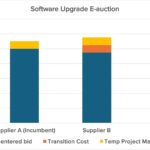
This one is changing as more businesses consider e-auctions for both direct and indirect purchasing. I am a BIG fan of using e-auctions for negotiating indirect purchases and have great results from doing so. I have repeatedly seen reductions in price/increases in value around 18-25% for indirect purchases beyond the value gained in the RFP. My favorite categories recently have been software implementations (not maintenance), debt collections, and temp/contingent labor. Software implementations are great once you’ve been through the RFP to refine the scope of work, communicated expected timelines, and agreed to the same expected results (not necessarily using the same method) with at least two suppliers. It’s even better if half the technical team prefers one proposal and the other half prefers another. I’ve consistently seen e-auctions for software implementation partners (think Accenture, InfoSys, Oracle, etc.) reduce further in price more than 20% through e-auction.
For debt collection and temp/contingent labor, I like to e-auction the supplier markup and have done so successfully multiple times. These are both very fractured markets with multiple suppliers, and those suppliers tend to be very hungry for business. A recent temp labor auction one of my clients ran reduced the supplier markup from around 48% to around 25% without changing what they pay the actual staff the company hires. It was an extremely competitive auction where the top two suppliers for each labor category would get the first chance to provide resumes and remaining suppliers would still see business if the first two did not have strong candidates. This strengthened the relationship with multiple preferred suppliers, reduced company costs, and still held their requirements for suppliers to provide benefits, time off, paperwork, etc.
E-auctions Work Better in Europe
“Our business over in Europe runs e-auctions, but we don’t run them here. Our Europe team has good success with them, but they just don’t work in the US.”
I’ve been on the phone with a number of Europe-based software companies who can’t figure out why e-auctions don’t have a stronger foothold in the US, and I have some personal theories based on what I’ve learned. First, there is clearly a strong cultural difference between European and US businesses and they center around regulation. The EU has been steadily passing more regulations governing Business-to-Business (B2B) commerce, and they tend to favor the supplier in a B2B relationship. While many of these regulations govern purchases of food and agriculture or even in the utility space, there is a perception that more industries fall under these same regulations. Perception can be stronger than law, and the assumption that suppliers will be protected from unfair practices can make them more willing to try alternative approaches when dealing with customers.
Second, when there was a boom in e-auctions in the early 2000s followed by a huge pulling away from auctions as a tool in the early 2010s, Europe didn’t adhere to either wave quite as fully as the US. The adoption of auctions in Europe seemed to be slower and more careful than in the US and therefore the pendulum swing away from auctions was less severe. With many Procure-to-Pay software companies headquartered in Europe, they have also continued to be a source of innovation and adoption in the e-auction space (Synertrade, Auxionize, and Jaggaer are a few examples). That means Europe is a little further on the Gartner Hype Cycle than the US and is in the “Slope of Enlightenment” or “Plateau of Productivity” while the US is stuck in the “Trough of Disillusionment”. Without more conversations about the benefit of e-auctions for suppliers (Transparency, Clarity and Speed), the US will simply keep staying in the Trough of Disillusionment and won’t see the value e-auctions can bring.
These are a few of the conversations I’ve had recently, which things that you or your team whisper did I miss? If you would like to talk about your e-auction objections or how you can run a couple without adopting a full software cycle, let’s chat. If you’d like to get these articles weekly straight to your inbox and never miss one, sign up for my newsletter.
My book, Transform Procurement: The Value of E-auctions is now available in ebook, paperback and hardcover format: https://www.amazon.com/dp/B0F79T6F25