
There’s SO MUCH excitement around this technology. Every other message on internet networks mentions it. Every conference talk has to include it or no one attends or listens. It’s going to revolutionize procurement and change how we serve customers, interact with suppliers, and reach savings goals. Every procurement software company is telling us how they’ve incorporated it into their platform “smoothly and natively.” Our CPOs are constantly asking if we’re using it.
Oh, did you think I was talking about AI? No, I was talking about e-auctions. In 2002.
Controversial hot take: AI is the new e-auction. Today let’s talk about why that is and what we should do about it.
The Technology Hype Cycle
If you’ve ever encountered the Gartner Hype Cycle, you know there’s a pattern to technology adoption (and not just in procurement technology).
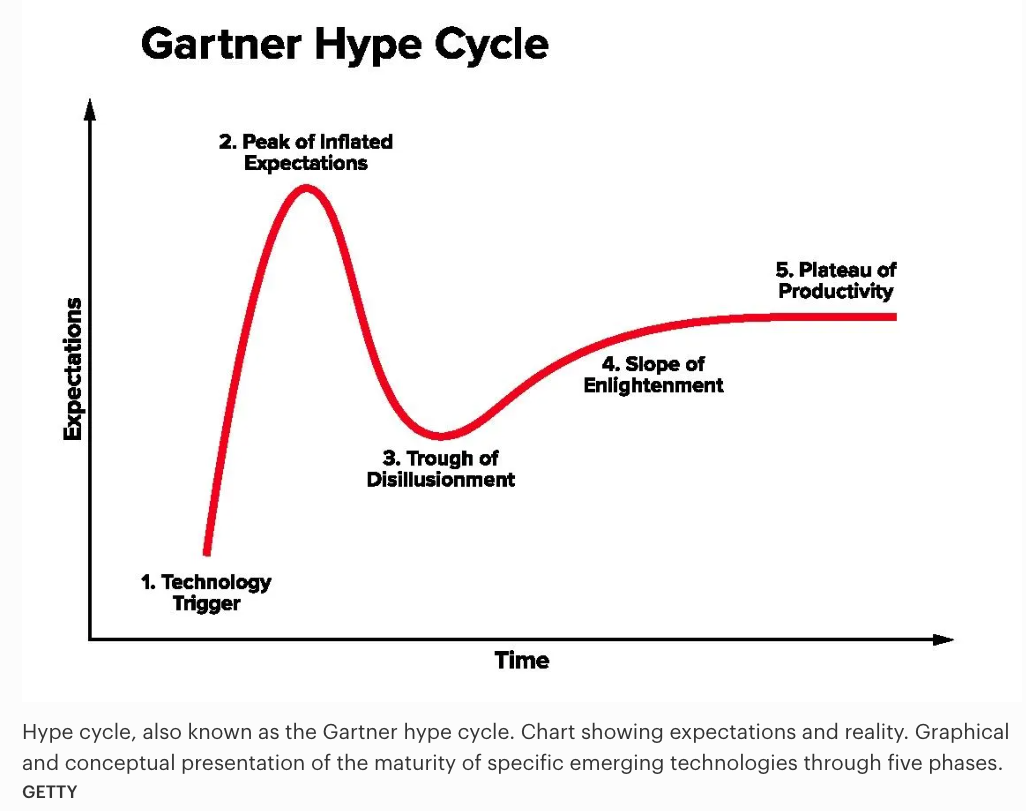
There’s a technology trigger first, then a peak of inflated expectations, then a trough of disillusionment, next a slope of enlightenment and finally a plateau of productivity. This curve might have a higher or lower peak, or it might get stuck at a phase longer than the graphic suggests, but it is a common cycle for technology adoption. Gartner has actually been putting AI in the “Trough of Disillusionment” since mid-2024, although AI is a big topic. Different types and aspects of AI are at different points on this curve, and large language models (such as ChatGPT) might be starting to climb out onto the slope of enlightenment. Yet AI in procurement technology is still falling into the trough of disillusionment. Software providers are still telling potential customers that the buyer can simply input a few things into a box, i.e. “Build me an e-auction with 20 lines from this excel file and invite suppliers A, B, and C. Make it run next Thursday.” and the software will build the rest. While I don’t think this is impossible, it’s also not here yet. More than that, it still requires heavy human intervention.
E-auction Similarity to AI
The need for human intervention is where the similarity to e-auctions comes in. Early on, e-auctions were pitched as, “You simply publish your bid and suppliers will fight one another for your business.” There are still companies and buyers who think this way, and there are a few companies with enough leverage that they can get away with this approach. Remember, e-auctions are a chainsaw, not a hammer. That means they must be handled with care and training and proper Personal Protective Equipment. A lot of buyers just tossed e-auctions onto the market without talking through their approach with suppliers, with poor scopes of work, and no initial RFI or RFP. They lost the human aspect to e-auctions, expecting the technology to just cover their needs. Does this sound similar to the current world of procurement AI?
The companies with sustainable e-auction programs are the ones who figured out how to talk about e-auctions to suppliers and stakeholders. The most successful businesses were not the companies who figured out the right categories to auction, but the companies who figured out how to tailor their negotiation approach to each bid. All of this sounds like AI right now. The companies who will succeed with AI are those who recognize that it’s merely a tool, and that humans are still needed to clarify, refine, and communicate the use of that tool. Companies who laid off employees, expecting to replace them with AI, are realizing they have to hire those people back. While I’m not ruling out a world where robots replace people, I think we’re still deep in the hype cycle with AI and we’ve only begun the stare into the pit that is the Trough of Disillusionment.
Garbage In, Garbage Out
Both e-auctions and AI suffer badly from the “garbage in, garbage out” phenomenon. In e-auctions, a poor scope of work will sink even the most suitable category, eager suppliers, and communicative buyer team. If you put terrible information into an auction, chances are very good the auction result won’t be sustainable. The winning supplier will easily justify massive change orders. The technical team will blame the e-auction team for suppliers not bidding on the work. I’ve seen it happen over and over and almost always find a poor scope of work at the root of the issue.
Similarly, poor data inputs will cause AI to output nonsense. I cannot find a clear source for this metric, but in my experience data needs to be 70-80% clean before AI can make use of it. While it’s possible to use AI to clean data, that may only take you so far. So just as a good scope of work is critical to an e-auction, good data is critical to AI. Otherwise, the garbage you put in simply becomes garbage on the way out.
Implementation>>Talk
How you talk about new technology matters. How you implement it matters more. Do you just sneak AI or e-auctions into your processes without telling people why, identifying some experts, and building new workflows? Culture might eat process for breakfast, but throwing new technology into the mix with no process will result in paying a lot and getting nothing. This is, of course, really just change management (which is another topic entirely, but I do have an article on convincing the skeptics). If you’ve decided to bring AI into your procurement processes, make sure you have a full, true implementation plan. And yes, I mean this even if you’re simply using the Microsoft Copilot that’s already part of your office suite. Just like e-auctions failed without resources to support them, expertise to understand them, and human compassion to make them understandable, AI will fail without the same.
What to Do About It
If AI is following the same path in procurement as e-auctions, what do we do about it? I would argue in many places e-auctions never left the trough of disillusionment. I spend significant time trying to pull e-auctions onto the slope of enlightenment, and I know what it feels like when technology gets stuck on the curve. So how do we keep AI for procurement from getting stuck in disillusionment, using the lessons learned from e-auctions twenty years ago?
- Keep humans involved and engaged. There is a tendency to expect technology to replace humans in multiple ways, but ultimately procurement is about relationships. The HR recruiting world shows us what happens when AI talks to AI and loses the human aspect. One AI tool writes our resumes and customizes our cover letters and then another AI screens those same resumes and conducts initial interviews. There is very little human contact in the recruiting system and it is creating a mess with both job hunters and HR teams everywhere. We can’t let procurement go the same way, with AI writing the full scope of work and sending out the bids, gathering bids and assessing them, and then placing orders without human intervention. I’ve even been asked about having AI participate in e-auctions instead of people. All of this is a slippery slope and will lead to excess (or short) inventory, incorrect specs, and angry stakeholders.
- Manage the technology change more intensely than you think is needed. There seems to be a perennial approach where leaders assume team members will simply adopt “great” technology with only a minimum amount of process improvement and training. Any change needs a change management process, even if the change is “use this attachment in the software we already have.” I don’t specialize in general change management, but if you don’t have change management skills within your organization, consider hiring them for any transformation, implementation, or expansion of technology use.
- Communicate benefits frequently and clearly. One of the key pieces of e-auctions is communicating with suppliers the benefits to their businesses. Suppliers get information about their place in the market (transparency). Suppliers see better scopes of work when the technical teams have to write more than “our incumbent knows what we need” (clarity). And suppliers get immediate feedback on if the business is likely to be theirs (speed). For AI, this probably looks like communicating with procurement professionals the benefits of using an AI tool to their daily work. Professionals no longer have to write a scope of work starting with a blank sheet of paper. They can process big bids or big data quickly and get surprising insights for use in RFIs, RFPs, and RFQs. Large language models can even be used to hunt for new suppliers, if allowed by company policy.
While the excitement around AI in procurement is palpable and real, it may also need to yield to prior cautionary tales. With e-auctions, that hype curve rose and fell so quickly and fully that we’re still learning how to use that tool sustainably. AI has great potential, but only if we can keep climbing the curve. If you’d like to talk about AI or e-auctions in your procurement team, let’s chat. If you’d like to get these articles weekly straight to your inbox and never miss one, sign up for my newsletter.
My book, Transform Procurement: The Value of E-auctions is now available in ebook, paperback and even hardcover format: https://www.amazon.com/dp/B0F79T6F25